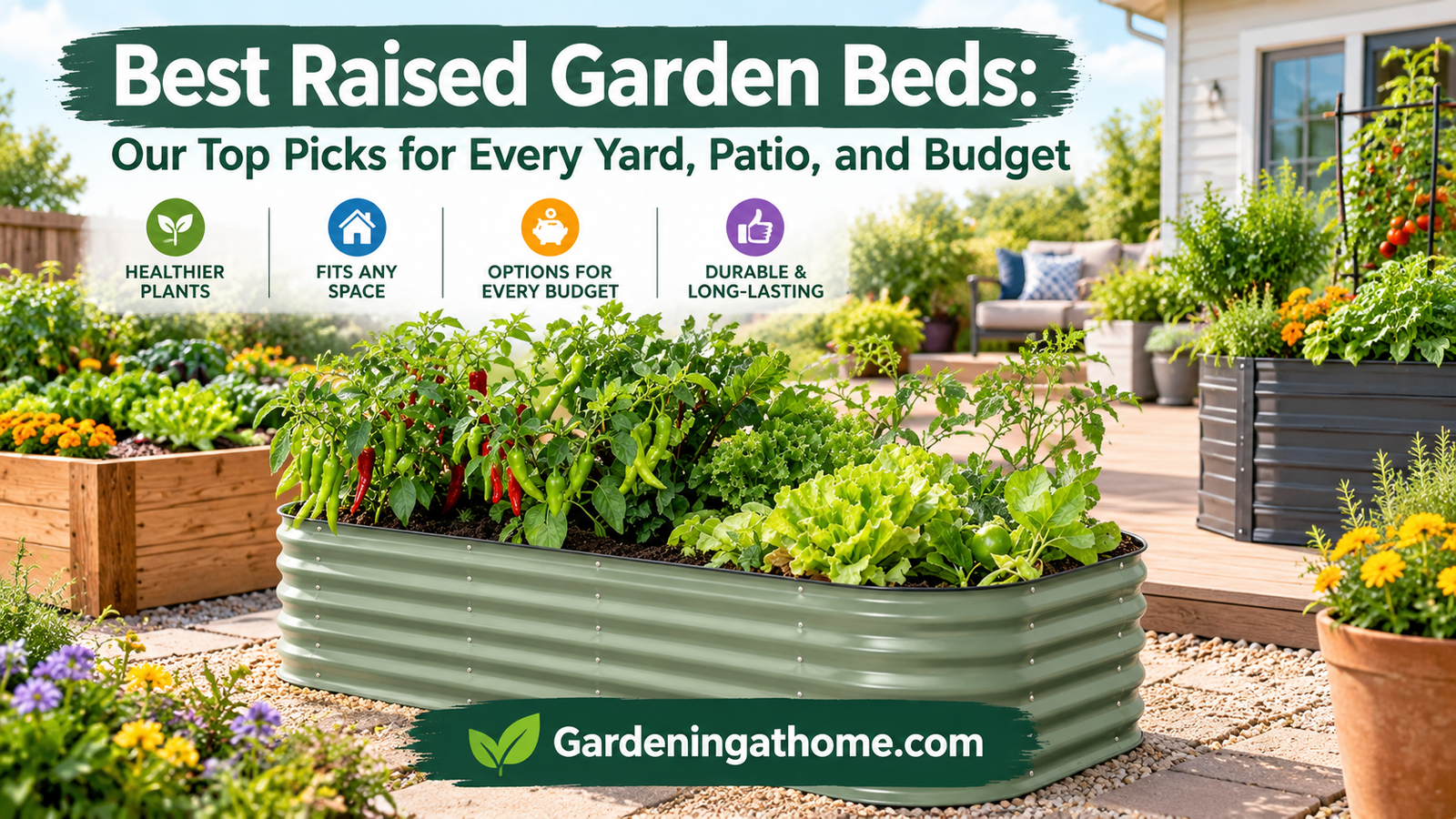
Best Raised Garden Beds: Our Top Picks for Every Yard, Patio, and Budget
A great raised garden bed does more than hold soil. It decides how easy your garden is to plant, water, and enjoy for years to come. Whether you are laying out your first vegetable plot or upgrading a patio full of herbs, the right bed can save your back, boost your harvest, and make the whole process feel simpler.
We rounded up seventeen of the most interesting raised garden beds, from modular metal kits and deep galvanized beds to cedar planters, tiered designs, fabric grids, and beds with built-in protection. If you are new to all of this, our hub page at Gardening at Home is a friendly place to start, and everything below is organized so you can jump straight to the style that fits your space.

Quick Comparison: Our Top Picks
Every bed in this guide is listed below. Scan the table, spot the style that suits you, then read the full reviews in the sections that follow.
| # | Image | Product | Key Specs | Verdict | Check Price |
|---|---|---|---|---|---|
| 1 | 
|
Vego Garden Modular Metal Raised Bed KitTop Pick Best Overall |
|
Flexible shapes and a sturdy build for serious growers. | Check Price on Amazon |
| 2 |
|
Land Guard 8x4x2 ft Galvanized Raised Garden Bed Best Large Capacity |
|
Huge, deep bed for roots, tomatoes, and big harvests. | Check Price on Amazon |
| 3 | 
|
Outland Living Tiered Raised Garden Bed Best Tiered Design |
|
Gets more growing zones out of a small footprint. | Check Price on Amazon |
| 4 | 
|
Keter Urban Bloomer Raised Garden Bed Best Low-Fuss Planter |
|
A tidy, easygoing bed for patios and porches. | Check Price on Amazon |
| 5 | 
|
Best Choice Products 6x3x2 ft Outdoor Metal Raised Garden Bed Best Budget Metal |
|
Deep metal bed that keeps costs sensible. | Check Price on Amazon |
| 6 | 
|
Lifetime 4×4 ft Outdoor Raised Garden Bed Best Classic Square |
|
The classic four-by-four starter plot. | Check Price on Amazon |
| 7 | 
|
Meberam 2-Pack 6x3x1 ft Galvanized Raised Beds Best Two-Bed Value |
|
Two beds in one purchase for crop rotation. | Check Price on Amazon |
| 8 | 
|
SPECRAFT 8×4 ft Wood Raised Garden Bed Best Natural Wood Look |
|
Warm, natural look with room for a full garden. | Check Price on Amazon |
| 9 | 
|
Infinite Cedar Premium Cedar Raised Garden Bed Best Premium Cedar |
|
Premium cedar for a long-lasting, handsome bed. | Check Price on Amazon |
| 10 | 
|
Gardener’s Supply Company Elevated Cedar Raised Bed (2×8) Best Elevated Cedar |
|
Waist-high cedar that saves your back. | Check Price on Amazon |
| 11 | 
|
LEETOLLA 32″ Elevated Raised Garden Bed with Wheels Best Mobile Bed |
|
Roll it into the sun or out of the storm. | Check Price on Amazon |
| 12 | 
|
AMERLIFE 8×2 ft Wood Raised Garden Bed Kit Best Narrow Wood Bed |
|
Slim, long bed that tucks along fences and paths. | Check Price on Amazon |
| 13 | 
|
Kingrol 8-Grid Fabric Raised Garden Bed (4×2) Best Fabric Bed |
|
Lightweight, breathable, and easy to store. | Check Price on Amazon |
| 14 | 
|
KING BIRD Raised Garden Bed with Anti-Bird Netting Best Bird Protection |
|
Built-in netting keeps hungry birds off your seedlings. | Check Price on Amazon |
| 15 | 
|
Quictent 6x3x1 ft Galvanized Bed with Cover Best With Cover |
|
A bed and a cover to extend your growing season. | Check Price on Amazon |
| 16 | 
|
FOYUEE 8x4x1 ft Galvanized Raised Garden Beds Best Wide Shallow Bed |
|
Big planting area for greens, herbs, and flowers. | Check Price on Amazon |
| 17 | 
|
Boldly Growing Cedar Raised Planter Box with Legs Best Standing Planter |
|
Handsome cedar planter at a comfortable height. | Check Price on Amazon |
Browse Raised Garden Beds
See more raised bed styles, sizes, and materials on Amazon.
Check Price on AmazonWhy Raised Garden Beds Are Worth the Investment
Ask a room full of gardeners what single change improved their results the most, and a surprising number will say the same thing: they stopped fighting their native soil and started building up instead. A raised bed gives you a defined, high-quality growing zone, and that one decision quietly solves a long list of gardening headaches at once.
Start with the soil itself. Backyard dirt can be compacted clay, stubborn rock, or sand that drains faster than roots can drink. In a raised bed, you choose the mix. You fill the frame with loose, nutrient-rich growing medium that roots can push through easily, and because nobody walks on it, it stays fluffy year after year. That is a bigger deal than it sounds. Roots that move freely produce healthier, more productive plants, and healthy plants are better at shrugging off pests and disease.
Drainage is the second advantage. Soil in a raised bed warms sooner in spring and sheds excess water more reliably after heavy rain. That means you can plant earlier, and you are less likely to lose seedlings to soggy roots. If you have ever dug into a spring garden and found cold, waterlogged ground, you already understand the appeal.
Then there is ergonomics. Bending over a ground-level plot for hours is hard on knees and backs, and elevated or tall beds bring the work closer to hand. Even a modest frame gives you a clear boundary, which makes weeding, mulching, and watering simpler. Weeds that creep in from the lawn have a harder time crossing a bed edge, and you can reach every plant without stepping on the soil.
Raised beds also make gardening approachable if you are new to it. If you are building your very first plot, our guide on how to start a vegetable garden walks through the basics, and the broader overview in how to start a garden from scratch helps you plan the entire space. A bed with clear edges turns a vague idea into a manageable project with a start and a finish.
Finally, raised beds are a natural match for small or paved spaces. City gardeners, patio growers, and anyone with poor ground can still grow real food, which is the heart of what we cover in what is urban gardening. Elevated beds, planters on legs, and fabric grids all let you garden where in-ground planting simply is not possible.
How We Chose the Best Raised Garden Beds
Choosing a list of the best raised garden beds is not about declaring a single winner for everyone. A balcony gardener and a market-minded vegetable grower need entirely different things. So instead of ranking beds in a vacuum, we looked at each option through the lens of how real gardeners actually use them.
What we looked at
- Material and build approach: metal, cedar, other wood, fabric, and planter-style designs all behave differently outdoors.
- Footprint and height: how much growing space the bed offers and whether the depth suits root crops or just greens.
- Ease of setup: kits that rely on a simple assembly process beat designs that need specialty tools.
- Accessibility: how easy it is to reach the middle of the bed and how much bending it requires.
- Special features: wheels, netting, covers, tiers, and modular layouts that solve specific problems.
- Value: what the bed offers for its place in the market, not just the sticker price.
Every bed in this guide was evaluated based on its published description and design approach, and we deliberately avoid quoting exact weights, thicknesses, or prices that can change from one listing to the next. When we do cite numbers, they come straight from the product name, such as an eight-by-four-foot footprint. For current details and pricing, always check the listing itself.
We also grouped the beds by category so that you can compare like with like. Metal beds sit together, wood and cedar beds sit together, elevated and tiered designs share a section, and protected or fabric beds have their own. Within each group we explain who each bed suits best, because the right choice depends far more on your space and habits than on any universal ranking.
A good raised bed is only one part of a productive garden. Good tools matter just as much, and if you are still building your kit, our list of essential gardening tools for beginners is a useful companion.
Raised Bed Materials Explained: Metal, Cedar, Wood, and Fabric
Material is the biggest decision you will make, because it affects durability, appearance, heat, and maintenance for years to come. Here is how the main options stack up in everyday gardening life.
Galvanized and other metal beds
Metal beds have exploded in popularity because they look crisp and are generally low maintenance. Galvanized steel is coated to help resist rust, which is why it appears again and again in this guide. Metal does not rot, it does not host the same wood-boring insects, and the edges stay clean-looking for years. Some gardeners worry about heat, but in most climates a well-watered bed with healthy soil buffers temperature swings nicely. If you live somewhere with scorching summers, simply mulch the surface and water consistently.
Cedar beds
Cedar is the premium choice in wood because it naturally resists decay and insects. It weathers to a soft silver, ages gracefully, and avoids the need for chemical preservatives, which is why many food gardeners favor it. The tradeoff is price, since quality cedar costs more than ordinary lumber.
Other wood beds
Standard wood beds offer a warm, traditional look at a gentler price point. They can last for many seasons with sensible care, but they are more vulnerable to moisture and weather than cedar or metal. Plan on checking joints and fasteners periodically, and expect to replace boards eventually.
Fabric beds
Fabric grow beds are lightweight, breathable, and nearly effortless to set up. The fabric allows air to reach roots and lets excess water escape, which discourages waterlogging. They are ideal for renters and for experimenting with a new layout, though they do not offer the lifespan of metal or cedar.
Elevated planters and tiered designs
These are less about the material and more about the form. Raising the soil to waist height or stacking tiers changes how you garden: less bending, more visual impact, and the ability to use hard surfaces. They hold less soil than ground-level beds, so they work best for herbs, greens, and compact vegetables.
Size, Height, and Placement: Getting the Layout Right
Before you buy anything, measure your space and watch how sunlight moves across it. A great bed in the wrong spot is a disappointing bed, so layout planning deserves a little time.
Width: the reach rule
A good rule is to make sure you can reach the center of the bed without stepping into it. For most adults, that means beds about three to four feet wide when accessible from both sides, and about two feet wide when placed against a wall or fence. Narrow designs like the eight-by-two kits are perfect for tight side yards, while four-foot-wide beds suit open lawns where you can walk around the whole thing.
Length: think about paths
Long beds are efficient, but remember to leave room for paths between them. Aim for walkways wide enough for a wheelbarrow, and think about where hoses and carts will go. If you plan to expand later, a modular system keeps your options open.
Height: depth for roots, comfort for you
A foot of soil is plenty for lettuce, herbs, radishes, and many flowers. Tomatoes, carrots, potatoes, and other deep-rooted crops appreciate closer to two feet, or at least soil that is loosened underneath. Taller beds also save bending, but they cost more to fill. Choose the depth based on what you actually want to grow.
Sunlight
Most vegetables want plenty of direct sun, while leafy greens and some herbs tolerate partial shade. Track the sun for a few days before committing. If you are unsure how to read your yard, our explainer on full sun versus partial shade makes the terms easy to apply.
Plan your planting grid
Once the bed is chosen, plan what goes where. Intensive layouts are especially effective in compact beds, and our overview of the best plants for square foot gardening offers a head start on spacing and crop combinations.
Level and stable ground
Set the bed on level ground and check it with a spacing check on all sides. A level bed waters evenly and keeps soil from sliding to one end. On slopes, consider terracing or choosing a smaller bed so the frame does not twist.
Shop Garden Measuring Tools
A tape measure and a level save a lot of guesswork.
Check Price on AmazonBest Metal Raised Garden Beds
Metal beds are the workhorses of the raised garden world. They go together quickly, hold their shape, and look clean from the first day to the last. In this group you will find a modular kit, two deep family-size beds, a budget-friendly option, and a two-pack for rotation. Here is a quick look before the full reviews.
| # | Image | Product | Key Specs | Verdict | Check Price |
|---|---|---|---|---|---|
| 1 |
|
Vego Garden Modular Metal Raised Bed KitTop Pick Best Overall |
|
Flexible shapes and a sturdy build for serious growers. | Check Price on Amazon |
| 2 |
|
Land Guard 8x4x2 ft Galvanized Raised Garden Bed Best Large Capacity |
|
Huge, deep bed for roots, tomatoes, and big harvests. | Check Price on Amazon |
| 5 |
|
Best Choice Products 6x3x2 ft Outdoor Metal Raised Garden Bed Best Budget Metal |
|
Deep metal bed that keeps costs sensible. | Check Price on Amazon |
| 7 |
|
Meberam 2-Pack 6x3x1 ft Galvanized Raised Beds Best Two-Bed Value |
|
Two beds in one purchase for crop rotation. | Check Price on Amazon |
| 16 |
|
FOYUEE 8x4x1 ft Galvanized Raised Garden Beds Best Wide Shallow Bed |
|
Big planting area for greens, herbs, and flowers. | Check Price on Amazon |
Vego Garden Modular Metal Raised Bed Kit
The Vego Garden kit earns the top spot because it solves a problem most raised beds ignore: gardens change. Your first season might call for a compact square beside the patio, and your third might call for a long rectangle along the fence. A modular metal system lets you reshape the footprint instead of buying a whole new bed.
Metal beds also tend to feel more permanent than their flat-pack wooden cousins. The panels give you crisp, clean edges, and the finished look suits both modern yards and traditional cottage gardens. If you want one purchase that can grow with your ambitions, this is where we would start.
Tips for success: sketch your layout on paper before assembly and decide where paths, trellises, and the water source will sit. Because the kit is modular, you can start with a footprint that fits this year’s ambitions and revisit it later. Set the panels on level ground, fill in stages, and water between layers so the soil settles evenly. Pair it with a drip line and a layer of mulch, and the bed becomes remarkably low-effort through the busiest part of summer.
Key Features
- Modular kit that can be arranged into different layouts
- Metal panels that suit a tidy, finished look
- Designed for long-term, repeated seasonal use
- A strong fit for vegetables, herbs, and cut flowers
Pros
- Adaptable to changing garden layouts
- Looks polished and intentional
- Built with a long-term mindset
Cons
- Usually costs more than entry-level beds
- Assembly rewards patience and a helper
Best for: Gardeners who want a bed that can be reconfigured later and who plan to garden for many seasons.
Ready to try the Vego bed?
Best Overall in our lineup. See current options and pricing.
Check Price on AmazonLand Guard 8x4x2 ft Galvanized Raised Garden Bed
If your goal is volume, the 8x4x2 footprint is the sweet spot. Eight feet by four feet lets you reach every corner from the edges, and a two-foot depth gives carrots, potatoes, and tomato roots the room they crave without any special tricks.
Galvanized steel is a popular choice because zinc coating helps the metal stand up to moisture. Pair that with the generous size and you have a bed that can anchor an entire vegetable garden. It is a commitment of space and soil, but the harvest payoff is real.
Tips for success: a bed this size rewards planning. Divide it mentally into zones, with tall crops like tomatoes and pole beans on the north side so they do not shade shorter neighbors, and low greens toward the south. Because the frame is deep, consider filling the lower portion with coarse organic material and topping with quality soil. Keep a path wide enough on both long sides, and you will be able to tend every plant without ever stepping inside.
Key Features
- Generous 8×4 ft footprint for a full vegetable plot
- Two-foot height for deep-rooted crops
- Galvanized metal construction
- Easy to reach across when sized at four feet wide
Pros
- Plenty of room for mixed planting
- Depth supports root crops
- Fewer beds to manage
Cons
- Needs a lot of soil to fill
- Requires a large, level spot
Best for: Families and market-minded growers who want one big, productive bed.
Ready to try the Land bed?
Best Large Capacity in our lineup. See current options and pricing.
Check Price on AmazonBest Choice Products 6x3x2 ft Outdoor Metal Raised Garden Bed
A six-foot by three-foot bed sits comfortably in most backyards, and the two-foot height is generous for the price tier. This Best Choice Products model is the one we point to when readers want metal durability without stretching the budget.
Three feet of width is also friendlier than four for shorter gardeners or anyone planting from one side only. You can reach the middle without stepping in, which protects your soil structure all season.
Tips for success: take your time during assembly, lay out all the parts first, and check that corners sit square before tightening everything. Set the bed in its final position before filling, because a full bed is nearly impossible to nudge. The two-foot depth is a great match for tomatoes and peppers, so consider reserving one end for taller crops supported by cages or a trellis.
Key Features
- Six-foot length that fits most yard layouts
- Three-foot width for easy reach
- Two-foot height for deeper roots
- Metal construction for outdoor use
Pros
- Good value for the depth
- Manageable footprint
- Easy to place along a fence
Cons
- Check edges and fit during assembly
- May need extra lining for very damp soil
Best for: Budget-minded gardeners who still want a deep, metal-sided bed.
Ready to try the Best bed?
Best Budget Metal in our lineup. See current options and pricing.
Check Price on AmazonMeberam 2-Pack 6x3x1 ft Galvanized Raised Beds
Buying beds in pairs changes how you garden. With two 6×3 beds you can rotate crops, separate heavy feeders from light ones, or dedicate one bed to perennial herbs while the other cycles through vegetables.
The one-foot height suits lettuce, radishes, herbs, onions, and many flowers. For deeper roots you can build soil beneath the bed by loosening the ground below, which turns a shallow frame into a deeper growing zone.
Tips for success: use the two beds as a rotation system. Plant heavy feeders like tomatoes and squash in one, and light feeders like greens and herbs in the other, then swap the next year. With one-foot sides, loosen the ground beneath the frame before filling so deeper roots can wander downward. Keep the beds parallel with a comfortable path between them, and a small trellis at the back of each will make good use of vertical space.
Key Features
- Two beds included in the pack
- Six-foot by three-foot footprint each
- One-foot height ideal for greens and herbs
- Galvanized metal for outdoor durability
Pros
- Great for rotation planning
- Strong value per bed
- Easy to arrange side by side
Cons
- One-foot depth limits deep roots
- Needs ground prep for long crops
Best for: Gardeners who want two matching beds and a simple rotation system.
Ready to try the Meberam bed?
Best Two-Bed Value in our lineup. See current options and pricing.
Check Price on AmazonFOYUEE 8x4x1 ft Galvanized Raised Garden Beds
Not every crop needs depth. Lettuce, spinach, radishes, herbs, and most flowers thrive in a foot of soil, and a shallow bed costs less to fill than a deep one.
FOYUEE gives you a wide eight-by-four canvas, making it a good fit for gardeners who value surface area over volume. Place it over loosened ground and roots can reach below the frame for extra depth.
Tips for success: a wide, shallow bed is ideal for succession sowing. Plant quick crops like radishes between slower ones like lettuce, and harvest in waves. Loosen the soil below the frame so roots can wander deeper than the foot of fill. Add a little shade cloth in the hottest part of summer to keep greens sweet and tender.
Key Features
- Wide eight-by-four foot surface
- One-foot height keeps soil costs lower
- Galvanized metal construction
- Great for salad gardens and cut flowers
Pros
- Lower soil cost than deep beds
- Lots of planting area
- Easy to access from either side
Cons
- Shallow for deep roots
- Needs good ground prep beneath
Best for: Salad, herb, and flower growers who want maximum surface area.
Ready to try the FOYUEE bed?
Best Wide Shallow Bed in our lineup. See current options and pricing.
Check Price on AmazonIf you are still deciding between depths, remember that tall beds suit root crops and tomatoes, while shallow beds are efficient for greens and herbs. Whichever you choose, keep a good pair of gloves nearby, because metal edges and soil work are easier on the hands with protection. Our roundup of the best gardening gloves can help.
Our Top Metal Pick
The Vego modular kit leads the metal category. See its current listing.
Check Price on AmazonBest Wood and Cedar Raised Garden Beds
Wooden beds bring warmth and a classic garden-center look. This group covers two cedar options, a large traditional wood bed, a narrow wood kit, and a classic four-by-four starter frame. Cedar costs more, but it earns that price through natural durability.
| # | Image | Product | Key Specs | Verdict | Check Price |
|---|---|---|---|---|---|
| 6 |
|
Lifetime 4×4 ft Outdoor Raised Garden Bed Best Classic Square |
|
The classic four-by-four starter plot. | Check Price on Amazon |
| 8 |
|
SPECRAFT 8×4 ft Wood Raised Garden Bed Best Natural Wood Look |
|
Warm, natural look with room for a full garden. | Check Price on Amazon |
| 9 |
|
Infinite Cedar Premium Cedar Raised Garden Bed Best Premium Cedar |
|
Premium cedar for a long-lasting, handsome bed. | Check Price on Amazon |
| 12 |
|
AMERLIFE 8×2 ft Wood Raised Garden Bed Kit Best Narrow Wood Bed |
|
Slim, long bed that tucks along fences and paths. | Check Price on Amazon |
SPECRAFT 8×4 ft Wood Raised Garden Bed
Wood has a visual warmth that metal cannot match, and the SPECRAFT 8×4 brings that cottage-garden charm to a full-size plot. Eight feet gives you room to plan rows, trellises, and companion plantings in one contiguous bed.
Wood also naturally insulates soil a little better against sudden temperature swings. Expect to monitor it over the seasons, since all wood weathers differently depending on your climate and how wet your yard stays.
Tips for success: choose your spot carefully before assembly, since a large wood bed is heavy once filled. Check that it sits level, and consider lining the ground with cardboard to block weeds. Over the seasons, keep an eye on the wood and refresh the soil level as it settles. A line of climbing beans or cucumbers along the back edge gives the bed a lush, productive look.
Key Features
- Eight-by-four foot growing area
- Natural wood appearance
- Fits comfortably against fences and walls
- Works for vegetables, flowers, or mixed beds
Pros
- Attractive natural finish
- Large planting space
- Blends into garden settings
Cons
- Wood weathers over time
- Heavier to move once filled
Best for: Gardeners who prefer a rustic look and want a large, traditional bed.
Ready to try the SPECRAFT bed?
Best Natural Wood Look in our lineup. See current options and pricing.
Check Price on AmazonInfinite Cedar Premium Cedar Raised Garden Bed
Cedar is the classic raised bed lumber because it naturally resists decay better than many other woods. That makes it a favorite for gardeners who want a bed that looks beautiful and lasts without chemical treatments.
Infinite Cedar positions itself in the premium tier, which means you are paying for the material and the craftsmanship. If you plan to keep the same bed in the same spot for many seasons, cedar is a sensible long-term investment.
Tips for success: cedar rewards a thoughtful setup. Place it on level ground with good drainage, and avoid piling mulch directly against the boards for long stretches. Let the wood age naturally to its silvery tone, or refresh the look with a food-safe finish if you prefer. Over the years this bed will often look better than it did at the start, which is a rare quality in garden products.
Key Features
- Cedar construction known for natural weather resistance
- Handsome grain that ages gracefully
- Suited to edible gardens
- Premium positioning for long-term use
Pros
- Naturally resists decay
- Beautiful, upscale look
- No need for harsh treatments
Cons
- Higher upfront cost
- Cedar still silvers with age
Best for: Gardeners who want a long-lasting, chemical-free wooden bed and don’t mind paying for it.
Ready to try the Infinite bed?
Best Premium Cedar in our lineup. See current options and pricing.
Check Price on AmazonAMERLIFE 8×2 ft Wood Raised Garden Bed Kit
Long, narrow beds are underrated. An eight-by-two layout slides neatly along a fence line, a driveway edge, or the side of a house, turning dead space into planting space.
Two feet of width means no stepping into the bed, which keeps soil loose and roots happy. It is a great pick for herbs, lettuce, bush beans, and flowers that benefit from being close to a walkway.
Tips for success: a narrow bed is perfect for rows. Plant in neat lines along the length, with taller crops at the back and shorter ones in front. Because the bed is only two feet wide, you can tend it from one side, which makes it ideal along a fence or wall. Use a drip line along the length and the whole bed can be watered in minutes.
Key Features
- Slim eight-by-two foot footprint
- Wood kit construction
- Ideal along fences and paths
- Easy to plant in tidy rows
Pros
- Fits tight side-yard spaces
- Easy reach from one side
- Clean linear planting
Cons
- Less room for sprawling crops
- Wood needs periodic checking
Best for: Gardeners with narrow strips of land or fence lines to use.
Ready to try the AMERLIFE bed?
Best Narrow Wood Bed in our lineup. See current options and pricing.
Check Price on AmazonLifetime 4×4 ft Outdoor Raised Garden Bed
A four-by-four square is the traditional starting point for square-foot gardening, and for good reason. Sixteen one-foot squares are easy to map, easy to water, and easy to reach from every side.
Lifetime is a recognized name in outdoor products, and this simple frame keeps the focus where it belongs: soil, seeds, and sunshine. If you are testing the waters before committing to a bigger layout, this is a low-risk way to begin.
Tips for success: treat the four-foot square as a grid of sixteen one-foot squares and plant accordingly. A few well-chosen crops, such as lettuce, radishes, herbs, and a tomato in one corner with a cage, give you a balanced first season. Because the bed is small, you can refresh its soil easily each year, and adding a second bed later simply doubles your options.
Key Features
- Classic 4×4 ft footprint
- Easy to reach from all sides
- Perfect size for grid-style planting
- Straightforward outdoor frame
Pros
- Ideal first bed
- Simple layout planning
- Easy to add more beds later
Cons
- Limited space for vining crops
- Single bed means fewer rotation options
Best for: First-time growers who want a proven, manageable size.
Ready to try the Lifetime bed?
Best Classic Square in our lineup. See current options and pricing.
Check Price on AmazonWood beds are at their best when you give them a little care. Keep soil from piling against the top edge, check fasteners from time to time, and avoid lining the inside with materials that trap moisture against the boards. A sturdy set of gardening tools makes upkeep much easier.
Best Elevated, Tiered, and Patio Raised Beds
Not everyone gardens at ground level. Elevated beds, tiered units, and planters on legs let you grow on decks, patios, and balconies, and they dramatically cut down on bending. The trade-off is soil volume: these beds hold less, so they dry out faster and suit smaller crops.
| # | Image | Product | Key Specs | Verdict | Check Price |
|---|---|---|---|---|---|
| 3 |
|
Outland Living Tiered Raised Garden Bed Best Tiered Design |
|
Gets more growing zones out of a small footprint. | Check Price on Amazon |
| 4 |
|
Keter Urban Bloomer Raised Garden Bed Best Low-Fuss Planter |
|
A tidy, easygoing bed for patios and porches. | Check Price on Amazon |
| 10 |
|
Gardener’s Supply Company Elevated Cedar Raised Bed (2×8) Best Elevated Cedar |
|
Waist-high cedar that saves your back. | Check Price on Amazon |
| 11 |
|
LEETOLLA 32″ Elevated Raised Garden Bed with Wheels Best Mobile Bed |
|
Roll it into the sun or out of the storm. | Check Price on Amazon |
| 17 |
|
Boldly Growing Cedar Raised Planter Box with Legs Best Standing Planter |
|
Handsome cedar planter at a comfortable height. | Check Price on Amazon |
Outland Living Tiered Raised Garden Bed
Tiered beds are the garden equivalent of a bookshelf: they stack your growing space upward instead of outward. That makes the Outland Living design a smart fit for patios, decks, and compact yards where ground area is limited.
Different levels also let you play with microclimates. Trailing herbs can spill from a lower tier while taller flowers or greens sit above. It is as much a display piece as a growing tool, which is a bonus when the bed sits near your seating area.
Tips for success: place the heaviest drinkers, such as basil and lettuce, on the lower tiers where water tends to collect, and drought-tolerant herbs like thyme and rosemary higher up. Check each level separately in warm weather, since upper tiers dry sooner. Choose a spot with a good amount of light, because shading from one tier onto another can affect growth. A tiered bed looks best when planting is generous and slightly trailing.
Key Features
- Multiple planting levels in one unit
- Space-saving vertical arrangement
- Attractive enough for patio display
- Good for mixing herbs, flowers, and greens
Pros
- Maximizes small spaces
- Adds visual interest
- Separates plant types neatly
Cons
- Individual tiers hold less soil
- Watering needs differ by level
Best for: Small-space gardeners who want a decorative bed that still produces.
Ready to try the Outland bed?
Best Tiered Design in our lineup. See current options and pricing.
Check Price on AmazonKeter Urban Bloomer Raised Garden Bed
Keter is a brand better known for outdoor storage and planters, and the Urban Bloomer brings that practical, no-nonsense approach to raised gardening. It is the kind of bed you set down on a patio, fill, and plant without a long afternoon of tool work.
Elevated planters bring the soil closer to hand height, which is kind to backs and knees. For herbs, salad greens, and a few flowers, a compact bed like this is often all a beginner needs to get hooked.
Tips for success: a compact bed like this thrives on consistency. Use a quality potting-style mix, water on a regular schedule, and feed lightly through the season. Herbs, lettuce, and flowers are natural fits. Move the bed into the light early in the day if you can, and keep the area around it clear so air circulates. It is a very easy way to build confidence before moving to larger projects.
Key Features
- Elevated planting height for easier tending
- Compact size suited to patios and porches
- Clean, modern outdoor styling
- Good starter bed for herbs and greens
Pros
- Easy on the back
- Neat and unfussy appearance
- Great for first-time gardeners
Cons
- Limited room for sprawling crops
- Smaller soil volume dries out faster
Best for: Beginners and apartment dwellers who want a simple, attractive planter bed.
Ready to try the Keter bed?
Best Low-Fuss Planter in our lineup. See current options and pricing.
Check Price on AmazonGardener’s Supply Company Elevated Cedar Raised Bed (2×8)
A two-by-eight elevated bed is a smart shape for accessibility. Two feet wide means you can reach the center from either side, and the elevated design lifts the work to a comfortable height so you stand instead of kneel.
Gardener’s Supply Company is a long-established name in gardening gear, and cedar adds natural weather resistance. This is the bed we recommend for anyone dealing with stiff knees, a sore back, or simply a preference for tidy, upright gardening.
Tips for success: because the bed is elevated, watering is the main chore. Group plants with similar water needs together and use mulch to slow evaporation. The narrow width is perfect for succession planting: sow a short row of lettuce or radishes every couple of weeks for a steady harvest. Place it close to a doorway or seating area so you enjoy it every day.
Key Features
- Elevated design that reduces bending
- Narrow two-foot width for easy reach
- Cedar for natural durability
- Long eight-foot run for rows of greens and herbs
Pros
- Gentle on backs and knees
- Easy reach from both sides
- Looks great on patios
Cons
- Less soil volume than ground-level beds
- Needs regular watering
Best for: Gardeners who want comfortable, standing-height tending.
Ready to try the Gardener’s bed?
Best Elevated Cedar in our lineup. See current options and pricing.
Check Price on AmazonLEETOLLA 32″ Elevated Raised Garden Bed with Wheels
Mobility is a surprisingly powerful gardening feature. A bed on wheels can chase the sun in spring, retreat from harsh afternoon heat in summer, and shuffle to shelter when a storm rolls in.
The 32-inch height also makes it a comfortable work surface. It suits renters especially well, since you can take the whole garden with you when you move, or rearrange a balcony without hauling bags of soil.
Tips for success: lock the wheels whenever the bed is in position, especially on uneven surfaces, and move it before it gets too heavy rather than after. In spring you can park it in the warmest corner, and in summer you can shuffle it to catch gentler afternoon light. It is a natural home for herbs, strawberries, and salad greens, which all do well with the extra attention that a close-at-hand bed encourages.
Key Features
- Wheels for repositioning
- 32-inch elevated working height
- Fits patios, decks, and balconies
- Great for herbs, salad greens, and small vegetables
Pros
- Move it for sun or shelter
- Comfortable standing height
- Renter friendly
Cons
- Limited soil depth for big roots
- Lock wheels on uneven ground
Best for: Renters, balcony gardeners, and anyone who wants a portable garden.
Ready to try the LEETOLLA bed?
Best Mobile Bed in our lineup. See current options and pricing.
Check Price on AmazonBoldly Growing Cedar Raised Planter Box with Legs
A planter box with legs is the gardening equivalent of a standing desk. Everything sits at a comfortable height, soil stays cleaner, and you spend less time hunched over your plants.
Boldly Growing uses cedar, which gives the box a natural, premium look and good resistance to outdoor conditions. It is a lovely choice for patios, decks, and entryways where the planter doubles as decor.
Tips for success: keep a saucer or catch tray under any planter you place on a deck, and check moisture frequently because raised planters dry out sooner. Choose herbs, flowers, and compact vegetables such as peppers or bush beans. Position the box where you will walk by it daily, and you will naturally notice when a plant needs water, a pinch, or a harvest.
Key Features
- Cedar construction
- Built-in legs for elevated planting
- Great patio and deck presence
- Perfect for herbs, flowers, and compact vegetables
Pros
- Easy on the back
- Attractive natural finish
- Keeps pests at a distance
Cons
- Smaller soil volume
- Needs consistent watering in summer
Best for: Patio gardeners who want an elegant, standing-height planter.
Ready to try the Boldly bed?
Best Standing Planter in our lineup. See current options and pricing.
Check Price on AmazonIf you garden on a balcony, our guide to balcony gardening ideas for apartments has layout ideas that pair well with elevated beds. And if you want to grow something bigger, you may enjoy learning how to grow tomatoes on a balcony. Smaller soil volumes also make pot sizing important, so see our advice on choosing the right pot size.
Our Top Elevated Pick
The Gardener’s Supply elevated cedar bed is a comfortable standing-height option.
Check Price on AmazonBest Fabric Beds and Protected Beds
Some gardeners need flexibility rather than permanence, and others need protection from birds, weather, or a short growing season. The beds in this section answer those specific problems.
| # | Image | Product | Key Specs | Verdict | Check Price |
|---|---|---|---|---|---|
| 13 |
|
Kingrol 8-Grid Fabric Raised Garden Bed (4×2) Best Fabric Bed |
|
Lightweight, breathable, and easy to store. | Check Price on Amazon |
| 14 |
|
KING BIRD Raised Garden Bed with Anti-Bird Netting Best Bird Protection |
|
Built-in netting keeps hungry birds off your seedlings. | Check Price on Amazon |
| 15 |
|
Quictent 6x3x1 ft Galvanized Bed with Cover Best With Cover |
|
A bed and a cover to extend your growing season. | Check Price on Amazon |
Kingrol 8-Grid Fabric Raised Garden Bed (4×2)
Fabric beds let roots breathe, and the eight-grid design makes it easy to organize crops without building dividers. Each pocket becomes its own mini garden, perfect for companion planting and herb collections.
They also fold flat for the off-season, which is a real convenience for renters and anyone short on storage. If you want to test raised bed gardening without a big commitment, fabric is the lowest-risk way in.
Tips for success: take advantage of the grid by assigning one crop or companion pair to each pocket. Water gently and often, since fabric breathes and dries out sooner than solid walls. Use quality soil rich in compost, and mulch the surface to hold moisture. At season’s end, empty the bed, let the fabric dry fully, and fold it away so it is ready for next spring.
Key Features
- Eight grid compartments for organized planting
- Breathable fabric supports healthy roots
- Lightweight and easy to relocate
- Can be stored when not in use
Pros
- Very easy to set up
- Portable and storable
- Great for experimenting
Cons
- Fabric ages faster than metal or cedar
- Soil can dry out sooner
Best for: Renters, beginners, and anyone who wants a flexible, low-commitment bed.
Ready to try the Kingrol bed?
Best Fabric Bed in our lineup. See current options and pricing.
Check Price on AmazonKING BIRD Raised Garden Bed with Anti-Bird Netting
Anyone who has watched a flock strip a row of seedlings knows the value of protection. This KING BIRD bed arrives with anti-bird netting, so your plants have a guard from day one.
Netting also helps with other flying pests and can reduce the need for improvised covers. For berries, leafy greens, and young seedlings, built-in protection is a time-saver that often pays for itself in saved crops.
Tips for success: install the netting before seedlings emerge so birds never learn the bed is a snack bar. Check the edges for gaps, and lift the netting gently when you harvest rather than leaving it open. Combine the bed with good watering habits, and your seedlings will get a protected start. Netting is especially effective for lettuce, strawberries, and other tender crops birds love.
Key Features
- Anti-bird netting designed to protect crops
- Raised bed structure for tidy planting
- Convenient all-in-one setup
- Useful for seedlings, greens, and berries
Pros
- Protects against birds out of the box
- Saves time on DIY covers
- Good for young plants
Cons
- Netting needs lifting for harvest
- Not a fix for ground pests
Best for: Gardeners whose crops keep getting raided by birds.
Ready to try the KING bed?
Best Bird Protection in our lineup. See current options and pricing.
Check Price on AmazonQuictent 6x3x1 ft Galvanized Bed with Cover
A cover turns a raised bed into a mini greenhouse for shoulder seasons. It can shield seedlings from unpredictable weather, protect tender plants from wind, and help you start earlier or finish later.
Pair that cover with a galvanized six-by-three frame and you have a flexible, weather-aware setup. It is a great choice for gardeners in places with fickle springs or early autumn chills.
Tips for success: a cover is a tool, not a lid. Open or vent it on warm days so plants do not overheat, and close it at night when temperatures drop. In spring, use it to start seedlings early. In autumn, use it to extend your harvest of greens. Watch humidity under the cover, and give plants room to breathe to avoid fungal trouble.
Key Features
- Galvanized metal frame
- Six-by-three foot planting area
- Cover for weather protection
- Suited to seed starting and tender crops
Pros
- Helps extend the season
- Shields young plants
- Doubles as a pest barrier
Cons
- One-foot depth limits deep roots
- Cover needs venting on warm days
Best for: Gardeners who want to start earlier and protect crops from weather.
Ready to try the Quictent bed?
Best With Cover in our lineup. See current options and pricing.
Check Price on AmazonProtection also matters beyond birds. If squirrels or larger animals are a concern, our practical guides on keeping squirrels out of the garden and keeping deer out of the garden cover fencing, deterrents, and layout tricks that complement any raised bed.
Our Top Protected Pick
KING BIRD includes anti-bird netting from day one. See the listing.
Check Price on AmazonFilling Your Raised Bed: Soil, Compost, and Layers
Your bed is only as good as what you put in it. Filling a raised bed can be the most expensive part of the project, so it pays to understand your options before you order anything.
Aim for a loose, balanced mix
The ideal raised bed mix is crumbly and rich, holding moisture without turning into mud. Many gardeners blend high-quality topsoil, finished compost, and an aeration ingredient such as perlite or coarse material. The exact ratio depends on your region and crops, but compost should be a major component because it feeds plants and improves structure.
Calculate volume first
Multiply length by width by depth to find cubic feet, then convert to cubic yards if you are ordering in bulk. Large beds such as the 8x4x2 foot format take a lot of material, while a one-foot-deep bed takes far less. Bulk delivery is often cheaper than bagged soil for big beds, and bagged mix is convenient for small planters.
Consider filling the bottom with organic material
For deep beds, some gardeners fill the lower portion with logs, branches, or leaves, then top with quality soil. This approach, sometimes called hugelkultur, reduces how much purchased soil you need and breaks down slowly over time. It is optional, but it can be a clever way to save money.
Protect against weeds from below
On grass or weedy ground, lay down plain cardboard before filling. It blocks weeds and breaks down naturally. Avoid plastic sheeting under the bed, since it prevents drainage and keeps roots from exploring deeper.
Container-style filling
Elevated planters and tiered beds behave more like containers and often do best with a quality potting-style mix. Our guide to the best soil for container gardening breaks down what to look for. For indoor setups and small pots, the best potting soil mix for indoor plants offers useful mixing ideas.
Feed your soil every season
Plants consume nutrients, and a bed that fed you last year needs replenishing this year. A top-dressing of compost each season does wonders. If you want a deeper feeding plan, read how and when to fertilize plants to learn the principles of timing and dosage that carry over to outdoor beds.
A simple step-by-step fill plan
Start by placing the empty bed in its final position and checking that it is level. Lay cardboard or a few sheets of newspaper over grass or weeds, overlapping the edges so nothing pokes through. Add your coarse organic layer first if you are using one, then pour in the main soil mix in stages, raking it level and watering lightly as you go. This staged approach lets the soil settle naturally and prevents large air pockets that can leave roots dry.
Leave an inch or two between the soil surface and the top of the frame. That gap keeps water and mulch from spilling over the sides during heavy rain, and it gives you a little room to top up with compost each season. Expect the level to sink a bit in the first few weeks, and plan to add more mix before your main planting.
Test, then tweak
If you are curious about what your soil needs, a basic test kit can tell you about pH and major nutrients. Most vegetables prefer soil that is slightly acidic to neutral, and a balanced compost-rich mix usually lands in the right range. Small adjustments, such as adding more compost or a gentle amendment, are easier in a raised bed than in the open ground because you control every ingredient.
What to Grow in Your Raised Bed
The fun part begins when you start planting. Raised beds are wonderfully versatile, and the best crop choices depend on your bed depth, sunlight, and the amount of time you can give them.
Start with easy wins
Lettuce, spinach, radishes, bush beans, herbs, and cherry tomatoes reward beginners with quick, visible results. If you have shallower beds, concentrate on leafy greens and herbs. Our list of the easiest vegetables to grow in pots is a great starting point, and the broader best vegetables for container gardening guide adds more ideas.
Mix in herbs and flowers
Herbs thrive in raised beds because the drainage suits them, and flowers invite pollinators that help your vegetables set fruit. See our picks for the best herbs for container gardening and the best plants for container gardening when planning your layout. If you want a showy summer bloom, how to grow sunflowers in a garden is a delightful read.
Think vertically
Trellises and cages turn a small bed into a high-yield space. Cucumbers, pole beans, peas, and tomatoes climb readily, leaving more room below for greens. Our guide to the best vegetables for vertical gardening covers which crops handle a trellis best.
Plan rotation and companions
Rotating plant families from season to season reduces pest and disease buildup, and pairing compatible crops makes better use of space. A two-bed system like the Meberam pack makes rotation especially simple, since you can swap heavy feeders and light feeders each year.
Match crops to depth
One-foot beds suit greens, radishes, herbs, and onions. Two-foot beds suit carrots, tomatoes, peppers, and potatoes. Use the bed height you chose as your planting cheat sheet.
Watering, Pest Control, and Seasonal Care
Once your bed is planted, steady care keeps it productive. Raised beds are forgiving, but they do have their own rhythm.
Watering
Raised soil drains well, which means it also dries out faster than ground soil. Check moisture with your finger an inch or two down, and water deeply rather than frequently. Drip lines or soaker hoses reduce waste and keep foliage dry. If you are unsure whether plants are getting too much or too little, our comparison of the signs of overwatering and underwatering will help you diagnose problems quickly.
Mulch
A layer of straw, shredded leaves, or compost keeps soil cooler, retains moisture, and suppresses weeds. It is one of the simplest habits with the biggest payoff.
Pests and wildlife
Birds, rabbits, squirrels, and deer can wreck a young garden overnight. Netting, row covers, and fencing are your best defenses, and some beds in this guide include protection built in. For tiny indoor and container pests, see how to get rid of fungus gnats naturally.
Seasonal upkeep
In spring, refresh the soil with compost and check your frame for loose fittings. During summer, keep up with watering and harvest often to encourage more production. In autumn, clear spent plants, add compost, and consider a cover crop or mulch for winter protection. Fabric beds can be emptied and stored, while metal and cedar beds usually stay in place year-round.
Season extension
Covers, low tunnels, and cold frames can stretch your growing window by weeks. A covered bed like the Quictent model makes the process simple, protecting young seedlings from chilly nights and drying winds.
A sample planting plan for a four-foot bed
If you want a concrete starting point, picture a four-by-four bed divided into sixteen squares. Give the back row to a tomato or two with sturdy cages, flanked by basil, which many gardeners enjoy growing alongside tomatoes. Use the middle rows for peppers, bush beans, and a few carrots or beets. Reserve the front row for fast, low-growing crops such as lettuce, radishes, and chives, which you can harvest early and replace with a second planting.
Succession planting is the secret of a busy bed. As soon as one crop finishes, sow something new in the gap. Spring lettuce can give way to summer beans, and summer beans can give way to autumn greens. A bed that is always growing something is a bed that is always paying you back.
Pollinators and companions
Tuck in a few marigolds, nasturtiums, or other flowers around the edges. They add color, attract helpful insects, and make the bed feel like a real garden rather than a production line. If you have a flower-friendly space indoors too, take a look at what flowers are good for an indoor garden for more inspiration.
Budget, Comfort, and Final Buying Advice
You have seen the options, so here is how to make the final call without second-guessing.
If you are on a budget
The Best Choice Products metal bed and the Meberam two-pack offer strong value, and a fabric bed such as the Kingrol is the lowest commitment of all. For more money-saving ideas, our collection of cheap gardening ideas for beginners shows how to stretch every dollar.
If you want the best overall bed
The Vego modular kit is our overall pick for its flexibility and long-term appeal. If you prefer wood, premium cedar from Infinite Cedar is the one to consider.
If you have limited space or mobility
Elevated cedar, planters on legs, and wheeled beds are your best friends. They bring the garden to you and make daily tending easy. Comfort gear also helps, such as the best knee pads for gardening and a good gardening stool for ground-level beds.
If you want to garden at scale
Go for the big, deep options: the Land Guard 8x4x2 foot bed for tall crops, the FOYUEE 8x4x1 foot bed for greens and herbs, or the SPECRAFT 8×4 foot wood bed for a classic look. Pair them with a good wheelbarrow to move soil and compost.
Common mistakes to avoid
- Buying too big too soon: a smaller bed you tend well beats a large one you neglect.
- Ignoring sunlight: a shaded bed will underperform no matter how great the soil is.
- Skimping on soil: poor fill undermines the whole project.
- Skipping paths: leave room to walk, kneel, and push a cart.
- Forgetting water access: place the bed near a spigot or hose.
Finally, protect yourself while you work. Durable gloves, sharp pruners, and a comfortable pair of gardening shoes make every session more enjoyable, and the best pruning shears for gardening keep plants tidy. For more ideas as your garden grows, browse our best gardening tips.
A simple weekly routine
Raised bed gardening feels lighter when it follows a rhythm. Once a week, walk the bed with a coffee in hand and look closely. Check moisture, pull any weeds while they are small, tie up climbing plants, and harvest anything ready. Scan leaves for holes, spots, or curling, because early detection makes most problems easy to solve. Ten or fifteen minutes of regular attention beats a long weekend of rescue work every time.
Keep a notebook or phone note with planting dates, varieties, and results. After a season or two, you will know exactly which crops thrive in your bed and which ones deserve a different spot. That kind of record turns each year into a head start for the next one.
Winter planning
When the growing season ends, resist the urge to leave bare soil exposed. A layer of compost, shredded leaves, or a cover crop protects the surface and feeds the bed for spring. Fabric beds can be drained, dried, and folded away. Metal and cedar beds are best left in place, and a quick check of fittings before the next season keeps everything solid.
Shop Gardening Essentials
Gloves, tools, and accessories for your new raised bed.
Check Price on AmazonFrequently Asked Questions
What is the best raised garden bed overall?
For most gardeners, a modular metal kit like the Vego Garden bed is the most flexible and long-lasting choice. If you prefer natural wood, premium cedar is an excellent alternative.
What size raised garden bed is best for beginners?
A four-by-four foot bed is a classic starting size because it is easy to reach, easy to plan, and easy to maintain. Narrow beds around two to three feet wide are also friendly because you can reach the center.
How deep should a raised garden bed be?
One foot is enough for lettuce, herbs, radishes, and many flowers. Tomatoes, carrots, and other deeper-rooted crops appreciate closer to two feet or well-loosened ground underneath.
Are galvanized raised beds safe for vegetables?
Galvanized steel beds are widely used for growing vegetables. As with any product, check the manufacturer’s information for the specific bed you choose and follow its guidance.
Is cedar better than other wood for raised beds?
Cedar naturally resists decay and insects, so it tends to last longer than most ordinary wood. It usually costs more, but many gardeners see it as a worthwhile long-term investment.
Do metal raised beds get too hot?
In most climates, a well-watered bed with healthy soil buffers heat effectively. Mulching and consistent watering reduce stress during hot spells.
What should I put in the bottom of a raised bed?
On grass or weeds, a layer of plain cardboard helps block growth from below. Deep beds can also be filled partly with logs or leaves before topping with quality soil. Avoid plastic sheeting, which blocks drainage.
How much soil do I need for a raised bed?
Multiply length by width by depth to find cubic feet. Larger beds, like an eight-by-four-by-two foot design, need a lot, while shallow beds need much less.
Can I put a raised bed on concrete or a patio?
Yes, but choose an elevated bed or planter with drainage, because ground-level beds without drainage can trap water. Elevated planters and wheeled beds are made for hard surfaces.
How do I protect my raised bed from birds and animals?
Netting, row covers, and fencing are the most reliable defenses. Some beds, like the KING BIRD model, include netting right in the kit.
Are fabric raised beds worth it?
Fabric beds are affordable, breathable, and easy to store, which makes them great for renters and beginners. They do not last as long as metal or cedar, but they are an easy way to start.
When is the best time to set up a raised bed?
Many gardeners assemble beds in late winter or early spring so soil is ready for planting, though autumn is also a great time to build and fill so soil can settle over winter.
Ready to Build Your Garden?
Explore raised garden beds and accessories on Amazon.
Check Price on AmazonConclusion: Pick the Bed That Fits How You Garden
The best raised garden bed is the one that matches your space, your crops, and your energy. If you want flexibility and long-term appeal, start with the Vego Garden modular kit. If you want volume, the Land Guard 8x4x2 foot bed delivers. If you value natural beauty, cedar from Infinite Cedar, Gardener’s Supply, or Boldly Growing is a lovely investment, and if you want something light and flexible, fabric beds like the Kingrol are the easiest way to begin.
Whatever you choose, remember that the bed is just the beginning. Fill it with rich soil, plant what you love to eat, and give it steady water and attention. A season from now you will be harvesting from a garden you built yourself, and you will be glad you took the time to choose well.
Start Your Raised Bed Garden Today
Find the perfect bed for your yard and start growing.
See the Top Pick on Amazon