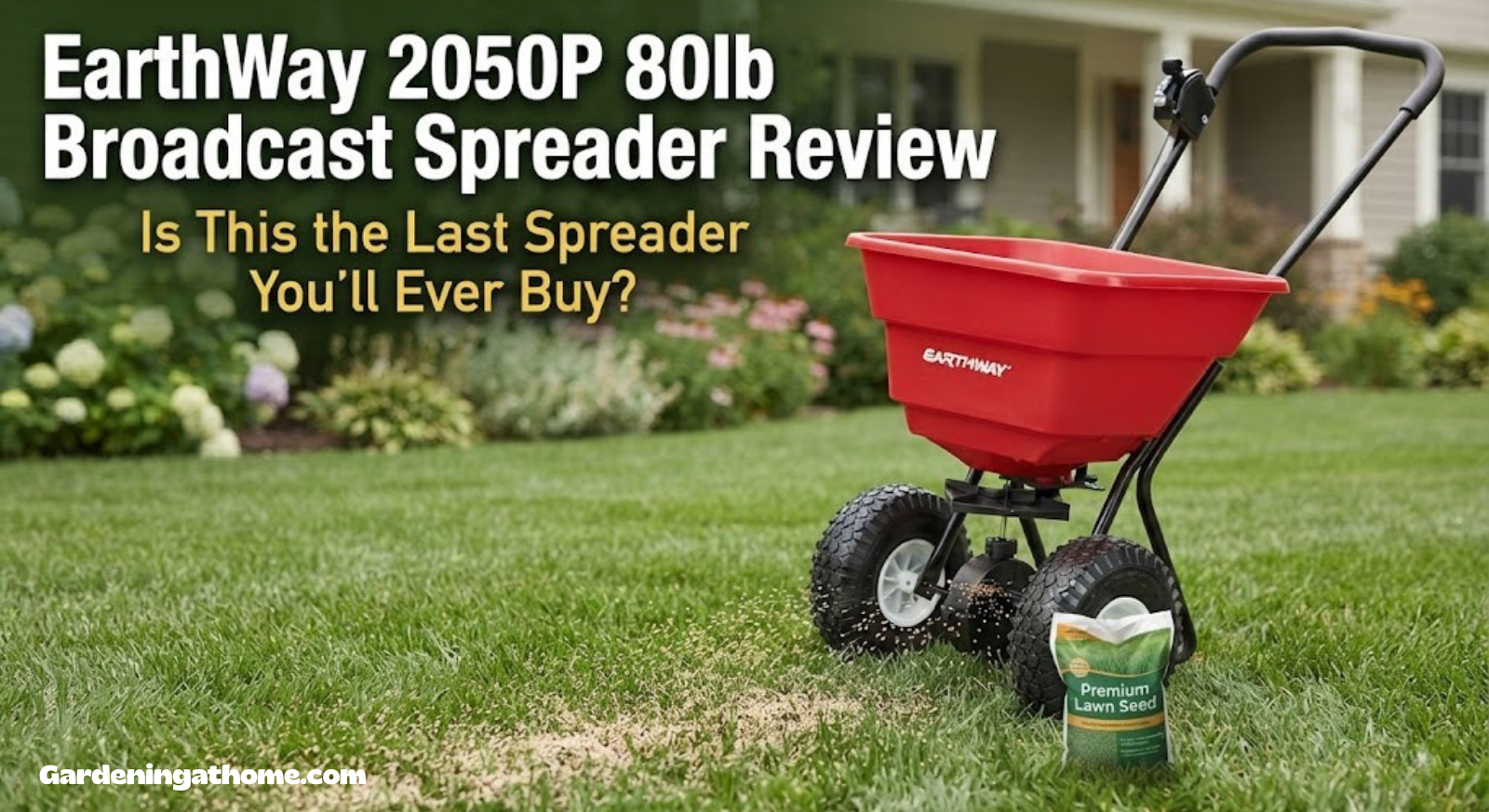
EarthWay 2050P 80lb Broadcast Spreader Review: Is This the Last Spreader You’ll Ever Buy?
A hands-on look at the spreader that’s been a staple in garden sheds for generations — tested for calibration accuracy, build quality, and real-world lawn coverage.


Check current pricing and availability for the EarthWay 2050P before you head into another mowing season.
Check Price on AmazonEarthWay 2050P Overview: What You’re Actually Buying
If you’ve spent any amount of time browsing lawn care forums, garden center aisles, or Amazon’s spreader category, you’ve almost certainly run into the EarthWay 2050P. It isn’t flashy. It doesn’t come with a companion app, a digital display, or a marketing campaign built around “smart lawn technology.” What it does have is a reputation that’s been earned the old-fashioned way — by working, season after season, for homeowners who just want an even, reliable spread without fuss.
The 2050P is EarthWay’s 80-pound-capacity push broadcast spreader, built around a poly hopper, a gear-driven mechanism, and pneumatic tires designed to roll smoothly over lawns, gravel, and uneven turf. It’s positioned as a step up from the smaller, entry-level EarthWay models, giving homeowners with mid-to-large properties enough hopper volume to cover more ground between refills.
In this review, we’re going to walk through everything: how it performed during actual lawn treatments, how the calibration dial holds up against real bag-recommended settings, what the build quality feels like after repeated use, and where it falls short. If you’re deciding whether this is the best lawn seed spreader for your yard, this breakdown should give you a clear, honest picture.
Who This Spreader Is For
Before getting into the granular details, it helps to frame who actually benefits from a spreader like this. The EarthWay 2050P sits in an interesting middle ground. It’s too much spreader for a tiny townhouse lawn — you’d be lugging around a half-empty 80-pound hopper for a patch of grass you could fertilize with a handheld shaker. But it’s also not quite at the scale of a tow-behind unit meant for acreage.
Where it shines is the quarter-acre to full-acre residential lawn. That’s the sweet spot where a walk-behind broadcast spreader with real hopper capacity saves you from constantly stopping to refill, but you still want something maneuverable enough to navigate around flower beds, trees, and property lines without a tractor attachment.
It’s also a strong fit for anyone who treats their lawn multiple times a year — spring fertilizer, summer insect control, fall overseeding, winterizer applications. Products like this earn their keep through repeated use, not a single spring application.
Unboxing and First Impressions
The spreader typically arrives partially assembled, with the hopper, wheels, and handle needing to be connected. Out of the box, the build feels substantial without being unwieldy. The poly hopper has a slightly translucent green tint that lets you gauge fill level at a glance, which is a small but genuinely useful detail once you’re out in the field and don’t want to stop and peer straight down into the bin.


The rate-control dial sits at the top of the handle, within easy reach, and the on/off lever is spring-loaded so the flow gate snaps shut the instant you release it — a small design choice that matters a lot once you’re actually spreading and need to stop precisely at a bed edge or driveway.
First impressions matter with garden tools because so many mid-tier spreaders feel like they’re held together with hope. The 2050P doesn’t give off that impression. The frame has some heft, the wheels roll with resistance that feels intentional rather than flimsy, and the hopper doesn’t flex alarmingly when full.
Build Quality and Materials
EarthWay has built its reputation on a fairly simple formula: heavy-gauge powder-coated steel frames paired with a poly hopper. The 2050P follows that formula closely. The frame is where most of the “will this survive years of use” confidence comes from — it’s noticeably thicker gauge steel than what you’ll find on many big-box store spreaders in a similar price range.
The Hopper
The hopper itself is a rugged, UV-stabilized poly material. This matters more than it sounds — cheaper spreaders often use hoppers that become brittle after a season or two of sun exposure, eventually cracking at stress points near the mounting brackets. EarthWay’s poly hopper has a long track record of resisting that kind of degradation, which is part of why so many of these spreaders end up lasting a decade or longer in real households.
The Gear Drive
Unlike some competitors that use a simple friction-drive mechanism (where the agitator spins based on wheel contact with the ground), the 2050P uses a fully enclosed gear-driven mechanism. This has two real benefits: it delivers more consistent agitation regardless of your walking speed, and it’s shielded from dirt, grass clippings, and moisture that would otherwise gum up an exposed gear.
The Pneumatic Tires
The tires are a genuine upgrade over the hard plastic wheels found on cheaper models. Pneumatic tires absorb bumps from tree roots, sprinkler heads, and uneven turf, which keeps the hopper more level as you walk — and a level hopper means a more even spread pattern.
| Component | Material | Notes |
|---|---|---|
| Frame | Powder-coated steel | Resists rust, holds shape under load |
| Hopper | UV-stabilized poly | Resists cracking and fading over time |
| Wheels | Pneumatic rubber | Smooths out bumps, improves spread consistency |
| Drive Mechanism | Enclosed gear drive | Consistent agitation, shielded from debris |
| Rate Control | Dial with numbered settings | Adjustable flow gate at hopper base |
Hopper Capacity and Real Coverage Numbers
The 80-pound capacity is the headline spec, and it’s a meaningful one. In practical terms, that means you can load a full 50-pound bag of fertilizer or grass seed with room to spare, rather than splitting a single bag across two hopper loads.
Spread width is rated up to 10 feet, though real-world width depends heavily on the material being spread — heavier, denser granules like some fertilizers throw farther and wider than lightweight grass seed, which tends to fall closer to the spreader. In testing across different materials, a more realistic working width for grass seed sat closer to 6–8 feet, while denser fertilizer granules approached the advertised 10-foot mark.
For a rough sense of scale: a full 80-pound hopper of standard lawn fertilizer, spread at a typical mid-range setting, comfortably covered between 15,000 and 20,000 square feet before needing a refill, depending on the product’s application rate. That’s a substantial amount of ground for a single load, and it’s a big part of why this model appeals to owners of larger lots who don’t want to be constantly walking back to refill.
| Lawn Size | Approx. Hopper Loads Needed | Estimated Time |
|---|---|---|
| Up to 5,000 sq ft | 1 partial load | 10–15 minutes |
| 10,000 sq ft | 1 load | 20–25 minutes |
| 20,000 sq ft | 1–2 loads | 35–45 minutes |
| 1 acre (43,560 sq ft) | 2–3 loads | 60–75 minutes |
If your property runs larger than an acre, you may want to compare this against a tow-behind option like the Agri-Fab pull-behind broadcast spreader, which trades maneuverability for even larger hopper capacity and less walking.
Calibration and the Settings Dial
Every broadcast spreader lives or dies by how accurately its settings dial matches real-world output, and this is a category where the 2050P earns genuine credit. EarthWay includes a settings chart that cross-references common fertilizer and seed brands with recommended dial positions, and in testing, those recommendations lined up reasonably closely with actual measured output.
That said, “reasonably closely” isn’t “perfectly,” and no settings chart accounts for humidity, granule size variation between manufacturing batches, or how fast an individual person walks. The dial gives you a strong starting point, not a guarantee. For anyone serious about avoiding stripes, burn patterns, or wasted product, doing a proper calibration test — measuring output over a known distance and adjusting from there — is still worth the ten extra minutes.
We’ve written a full walkthrough on how to calibrate a spreader that applies directly to this model, and it’s worth doing once per season or any time you switch to a noticeably different product.
Setting Adjustment on the Fly
The dial is positioned at the top of the handle, within thumb’s reach, which means you can adjust the rate mid-pass without stopping and bending down to the hopper base. That’s a genuinely useful feature if you’re transitioning between open lawn (wider setting) and tighter areas near beds or walkways (narrower setting) in a single session.

See the current settings chart and full spec sheet directly on the product listing.
View on AmazonCalibration Deep Dive: Matching Settings to Specific Product Types
The general calibration advice covered earlier applies universally, but the real-world experience of dialing in the 2050P becomes more nuanced once you start loading different product categories into the hopper. Each type of granular material — fertilizer, grass seed, lime, ice melt, insect control — has its own density, granule shape, and flow characteristics, which means a dial setting that works perfectly for one product can produce noticeably different results with another, even at the same walking speed and overlap pattern.
Standard Granular Fertilizer
This is the baseline most calibration charts are built around, and it’s where the 2050P’s settings dial most closely matches real-world output. Most major fertilizer brands produce granules in a relatively uniform size range (typically 2–4mm diameter), which flows consistently through the gate and produces a predictable throw pattern. For a standard 10-10-10 or 24-0-11 type product, the manufacturer’s recommended setting is usually a reliable starting point, with minor adjustments based on your specific walking speed. If you walk faster than average, bump the setting up one notch; if you walk slower than average, dial it back slightly. The gear-driven agitator handles uniform fertilizer granules without any bridging or flow issues under normal conditions.
Grass Seed
Grass seed calibration is where most new spreader owners run into their first frustrating learning curve. Seed is dramatically lighter and less uniform than fertilizer — different grass species have different seed sizes and weights, and even within a single bag, there’s meaningful variation. The 2050P’s settings chart provides recommended positions for common seed types (tall fescue, Kentucky bluegrass, perennial ryegrass, etc.), but these should be treated as rough starting points rather than precise prescriptions.
The key insight is that grass seed flows through the gate more readily than its light weight might suggest, because the small, irregular shapes allow air gaps between seeds that actually facilitate movement. The real challenge isn’t getting seed out of the hopper — it’s controlling how far it throws, since lighter seeds drop out of the broadcast pattern much closer to the spreader than fertilizer granules do. In practice, the most effective approach is to reduce the dial setting slightly below the chart recommendation and compensate with tighter overlap between passes, which produces more uniform coverage than relying on a wider throw pattern that may be inconsistent at the edges.
Pelletized Lime
Pelletized lime is one of the heavier products you’ll load into the 2050P, and its density works in the spreader’s favor. Lime pellets are typically dense, uniform, and dry, which means they flow cleanly through the gate and throw wide and consistently. Calibration for lime is usually straightforward — the chart setting tends to be accurate, and the main variable is application rate rather than pattern consistency. Because lime applications are typically measured in pounds per thousand square feet, and lime is denser than fertilizer, you’ll often run a lower dial setting than you would for a fertilizer pass to avoid over-applying.
Grub and Insect Control Granules
Granular insect control products introduce the most variability of any common spreader input, because granule size and density can vary significantly not just between brands but between batches of the same product. Some insect control granules are lightweight and almost powdery at the edges of the particle size range, while others are coated and relatively dense. This variability is where the 2050P’s gear-driven agitator earns its keep — it maintains consistent agitation regardless of granule characteristics — but the throw pattern still shifts meaningfully with lighter products.
The practical recommendation for insect control products is to start one setting below the chart recommendation, walk at a deliberately slow and consistent pace, and apply a half-rate in two perpendicular passes (north-south, then east-west) rather than trying to get full coverage in a single directional pass. This cross-hatch approach smooths out any inconsistencies in the throw pattern and is widely recommended by turf professionals for products with variable granule characteristics.
Ice Melt and Rock Salt
While not a lawn care product per se, ice melt applications are a legitimate secondary use for the 2050P during winter months, and calibration considerations are worth noting. Ice melt products are dense, heavy, and often slightly damp depending on storage conditions, which means they throw wide and fast through a broadcast spreader. Start with a lower dial setting than you think you need, because over-application of ice melt on driveways and walkways wastes product and can damage adjacent grass and garden beds when spring arrives. The spreader handles these products mechanically without issue, but the post-use cleaning routine becomes critically important given ice melt’s corrosive properties.
Real-World Performance: Spring, Summer, and Fall Testing
To get a full picture, this spreader was run across three different seasonal applications: a spring granular fertilizer pass, a summer grub control application, and a fall overseeding session.
Spring Fertilizer Application
Fertilizer granules are relatively heavy and uniform, and this is where the 2050P performed most confidently. The spread pattern was even, with minimal skipping, and the fan-shaped distribution pattern extended reliably to both sides of the walking path. Overlap at roughly half the spread width (a standard technique) produced a visibly consistent green-up with no obvious striping once the fertilizer had a chance to work in.
Summer Grub Control
Granular insect control products tend to be lighter and more irregular in shape than fertilizer pellets, and this is where minor inconsistency showed up. At higher walking speeds, the throw pattern narrowed slightly on the edges. Slowing down and using a slightly wider overlap corrected this without much added effort.
Fall Overseeding
Grass seed is the lightest material tested, and predictably, it had the shortest and most speed-sensitive throw distance. For anyone using this spreader specifically for overseeding a lawn with a spreader, the practical takeaway is to walk at a slow, consistent pace and use tighter overlap than you would with fertilizer — otherwise thin strips can appear where seed density drops off between passes.
What Performed Well
- Even distribution with denser granular fertilizer
- Quick-response on/off gate for precise stopping
- Minimal clumping thanks to the gear-driven agitator
Where It Struggled
- Lightweight seed narrowed spread width at faster walking pace
- Edge distribution dropped off slightly on inconsistent granule products
Organic vs Synthetic Fertilizer: Does the Spreader Care?
As more homeowners shift toward organic lawn care practices, a practical question arises: does the type of fertilizer — organic versus synthetic — change how a broadcast spreader performs? The short answer is yes, in some meaningful ways, and understanding those differences prevents the frustration of expecting identical results from two fundamentally different types of product.
Synthetic Granular Fertilizer
Synthetic fertilizers are manufactured with controlled, uniform granule sizes, which is one of the main reasons they flow so predictably through broadcast spreaders. The 2050P handles synthetic granules with consistent throw distance, even distribution, and minimal bridging in the hopper. This consistency is partly by design — synthetic fertilizer manufacturers know their products will be applied with spreaders, and they engineer granule size accordingly. The uniform shape and density of synthetic granules means the calibration chart settings tend to be most accurate for these products, and the spread pattern remains stable across a wide range of walking speeds.
Organic Granular Fertilizer
Organic fertilizers present more variability. Because they’re derived from natural sources — bone meal, feather meal, composted manure, seaweed extract — the granule size, shape, and density tend to be less uniform than synthetic alternatives. Some organic products are pelletized for easier spreading, which brings them closer to synthetic fertilizer in terms of spreader performance, but others are more irregular and granular in texture.
When loading an organic fertilizer into the 2050P, expect a slightly narrower and less predictable throw pattern compared to a synthetic product at the same dial setting. The gear-driven agitator helps maintain consistent flow, but the irregular granule shapes can produce minor density variations across the spread width. The practical solution is the same one that works for any less-uniform product: walk at a slower, more deliberate pace and increase your overlap between passes. For the best results, consider making two perpendicular passes (north-south, then east-west) at half the recommended rate each, rather than a single full-rate pass. This cross-hatch technique smooths out the density inconsistencies that irregular organic granules can introduce.
Moisture Sensitivity Differences
Another consideration with organic fertilizers is moisture absorption. Many organic products are more hygroscopic than synthetic fertilizers, meaning they absorb ambient moisture more readily, especially in humid conditions or if the bag has been opened and resealed multiple times. Damp organic fertilizer can bridge above the flow gate or clump inside the hopper in ways that dry synthetic products rarely do. Storing organic products in a sealed, dry container until immediately before use, and breaking up any visible clumps before loading them into the hopper, prevents most of these issues. The 2050P’s gear-driven agitator handles minor clumping better than friction-driven spreaders, but it’s not immune to the effects of moisture-compacted product.
Application Rate Differences
Organic fertilizers typically have lower NPK analysis numbers than synthetic products, which means you’re often applying a higher volume of product per thousand square feet to deliver the same amount of actual nutrients to the soil. This translates directly into faster hopper consumption and potentially more refills per session. A synthetic fertilizer with a 24-0-11 analysis might be applied at 3–4 pounds per thousand square feet, while an organic product with a 4-3-2 analysis might require 10–15 pounds per thousand square feet for equivalent nutrient delivery. The 2050P’s 80-pound hopper capacity helps absorb this difference without making the session unbearably long, but it’s worth calculating your total product needs in advance so you know how many hopper loads to expect.
Blended Products
Many lawn care products on the market today are blends that combine synthetic and organic ingredients — for example, a fertilizer with both synthetic nitrogen and organic matter-based micronutrients. These blends typically spread more like a synthetic product because the manufacturing process still produces relatively uniform granules, so the 2050P handles them well at standard chart settings. Reading the product label to understand the granule composition helps you set realistic expectations for spread pattern and coverage consistency before you start.
Ease of Use and Handling
Weight distribution is one of the more underrated aspects of any push spreader, and it’s a strong point here. Even with a full 80-pound hopper, the handle doesn’t feel like it’s fighting you — the pneumatic tires and low center of gravity keep the unit tracking straight rather than veering.
Turning at the end of a pass (with the flow gate closed) is smooth, and the wheels don’t dig into soft turf the way narrower plastic wheels sometimes do. On slopes, the added weight of a full hopper does require a firmer grip, but that’s true of essentially any spreader in this capacity range, not a specific flaw of this model.
The handle height suits most adult users comfortably, though very tall or very short users may want to check the measurements against their own height before assuming a perfect ergonomic fit, since the handle isn’t adjustable.
If you’re newer to spreading grass seed specifically, our guide on how to spread grass seed evenly covers walking pattern and overlap technique that applies directly to getting the most out of this machine.
Protecting Yourself While Spreading — Gloves, Chemical Safety, and Best Practices
It’s easy to treat spreading fertilizer or lawn chemicals as a low-risk activity — you’re walking across your own yard, not handling industrial solvents. And while the acute danger level is indeed low compared to many household tasks, the repeated, seasonal nature of lawn chemical application means cumulative exposure matters. Fertilizers, herbicides, insecticides, and even lime can cause skin irritation, respiratory issues, or eye damage with enough contact over time, and the simplest way to prevent those outcomes is basic protective gear worn consistently.
Gloves: Your First Line of Defense
Gloves are the single most important piece of protective equipment for any spreading session, and the type of glove matters more than most people realize. Thin latex or nitrile disposable gloves provide a chemical barrier but tear easily when handling spreader controls, bags of product, or the spreader itself during loading. A better option for most homeowners is a reusable nitrile-coated work glove that combines chemical resistance on the palm and fingers with a breathable back for comfort during longer sessions.
For spreading tasks specifically, nitrile-coated gloves hit the sweet spot between dexterity and protection — you can operate the spreader’s rate dial, grip the handle comfortably, and handle product bags without the gloves getting in the way. Our comparison of nitrile vs latex gardening gloves walks through the specific chemical resistance and durability differences that matter for lawn care work, and our broader guide to the best gardening gloves covers options across all use cases, including heavy-duty chemical handling.
Eye and Respiratory Protection
Eye protection is often overlooked for granular spreading, but wind can blow fine dust and granule fragments back toward your face, especially when pouring product from a bag into the hopper or when spreading on a breezy day. A simple pair of safety glasses or wraparound sunglasses provides adequate protection for most granular products. For powdered or dusty products like pelletized lime or certain organic fertilizers, a basic dust mask adds another layer of protection and is worth the minimal discomfort, particularly if you’re sensitive to airborne particulates.
Clothing Considerations
Long pants and closed-toe shoes are the minimum for any spreading session. Fertilizer granules that land on bare skin can cause irritation, especially on sweaty skin during warm-weather applications. Shoes should have some tread — the spreader’s pneumatic tires roll well over grass, but the operator is walking the same terrain, and slipping on a wet slope while carrying or pushing an 80-pound loaded spreader is a genuine safety concern that shouldn’t be underestimated.
For shoes, any sturdy outdoor shoe or boot works well. For gloves used specifically around chemical products, leather gardening gloves offer good general protection but may absorb chemical residues more than synthetic-coated alternatives. Our guide to the best leather gardening gloves covers options that balance durability with washability — an important factor when gloves are used for chemical applications and need regular cleaning to prevent residue accumulation.
Hygiene After Spreading
The most common mistake with chemical safety isn’t a dramatic accident — it’s the routine of heading inside after a spreading session without washing hands thoroughly, or touching your face during a session with contaminated gloves. Establishing a simple habit of removing gloves before touching door handles, washing hands and forearms immediately after each session, and storing contaminated gloves away from living spaces prevents the kind of low-level chronic exposure that builds up over multiple seasons.
Showering after a heavy spreading session, particularly with herbicide or insecticide products, is a reasonable precaution. Fertilizer is generally less irritating to skin, but any product that’s designed to deliver concentrated nutrients or pest control chemicals to biological organisms deserves basic respect as a potential irritant to human skin and mucous membranes as well.
Pet Considerations During Application
While we cover post-application pet safety in a dedicated section later in this review, it’s worth noting here that pets should be kept completely away from the spreading area during active application. Dogs in particular are drawn to investigate the spreader and the granules being distributed, and direct ingestion of fertilizer or lawn chemicals during application — before they’ve had a chance to water in and settle — poses the highest risk window. Keeping pets indoors during the actual spreading session and for the recommended waiting period afterward eliminates this risk entirely.
Durability and Weather Resistance
Steel frame spreaders live outdoors more often than owners like to admit, even when the instructions say to store them under cover. The powder-coated finish on the 2050P holds up reasonably well against surface rust, though any bare metal exposed through a scratch or ding will eventually need a touch-up coat of rust-resistant paint if the unit is left outside long-term.
The poly hopper is the more durable component of the two in terms of weather resistance — it doesn’t rust, and UV degradation is slow enough that most owners won’t notice meaningful brittleness for several years of regular seasonal use.
The biggest long-term durability factor isn’t weather exposure at all — it’s leftover product sitting in the hopper. Fertilizer and lime residue is corrosive, and letting it sit in the hopper or on the frame between uses is the single fastest way to shorten a spreader’s lifespan, regardless of brand or price point.
Assembly and Maintenance
Assembly is straightforward and typically takes under 20 minutes with basic hand tools (a wrench and screwdriver cover most of it). The main steps involve attaching the wheels to the axle, securing the frame legs, and mounting the hopper and handle assembly. The included instructions are clear enough that most owners won’t need to hunt down a video walkthrough, though EarthWay’s manuals are available online if needed.
Ongoing Maintenance Checklist
| Task | Frequency | Why It Matters |
|---|---|---|
| Rinse hopper and frame | After every use | Prevents corrosive residue buildup |
| Dry thoroughly before storage | After every use | Reduces rust risk on metal components |
| Check tire pressure | Monthly during season | Keeps hopper level for even spread |
| Inspect flow gate seal | Start of each season | Prevents leaking or inconsistent flow |
| Lubricate axle | Once or twice a season | Keeps wheels rolling smoothly |
Winterizing Your Spreader: Off-Season Storage Done Right
For most homeowners in temperate climates, the spreader sits unused for three to five months between the last fall application and the first spring session. How you treat the spreader during that idle period has an outsized impact on its condition when you pull it out again, and skipping a few simple winterizing steps is one of the most common reasons owners encounter stuck gates, corroded frames, or seized axles at the start of a new season.
The Pre-Storage Deep Clean
The standard post-use rinse recommended in the maintenance section is designed for quick cleaning between applications during the active season. Before winter storage, a more thorough cleaning effort pays dividends. Start by emptying any remaining product from the hopper — even small amounts of fertilizer or lime left inside will absorb moisture over the winter and create a corrosive paste that attacks both the hopper interior and the flow gate mechanism. Don’t just tip the spreader over and call it done; shake the hopper gently and use a small brush to dislodge any granules stuck in corners or around the agitator assembly.
After emptying, rinse the entire spreader — hopper, frame, wheels, axle, and gate mechanism — with a garden hose. Pay special attention to the flow gate track, where granular residue tends to accumulate and harden into a cement-like crust over months of storage. A stiff-bristled brush helps dislodge any compacted material in the gate track and around the agitator housing. After rinsing, let the spreader air dry completely before storing it. Trapping residual moisture inside a closed storage space accelerates rust formation on any steel component, which means the frame, axle, and gate hardware all degrade faster if put away wet.
Tire Care During Storage
Pneumatic tires lose pressure slowly over time, and a spreader stored for months on underinflated tires can develop flat spots that create an uneven spread pattern the following season. Before winter storage, check that both tires are inflated to their recommended pressure using a standard tire gauge. If your storage area experiences extreme temperature swings — an unheated garage in a northern climate, for instance — the tires may need a top-up in spring as well, since cold air contracts and drops tire pressure even without any actual leak in the tube.
If the tires have been slowly losing pressure throughout the season, now is also a good time to inspect them for punctures, cracked valve stems, or sidewall damage. Replacing a worn tire before storage is easier and cheaper than discovering a flat tire the morning you planned your first spring fertilizer application.
Location Matters
Ideally, the spreader should be stored in a dry, enclosed space — a garage, garden shed, or covered storage area. Storing it outdoors under a tarp is better than leaving it fully exposed to rain and snow, but tarps trap condensation against the equipment, which can be almost as damaging as direct precipitation over a long storage period. If outdoor storage is unavoidable, a breathable cover designed for outdoor equipment provides better moisture management than a standard plastic tarp that seals humidity against the frame.
Vertical storage with the hopper facing outward, as mentioned in the storage section, remains the most space-efficient approach, and it also keeps the hopper open to air circulation rather than trapping residual moisture inside a closed container shape. Standing the spreader on its wheels against a garage wall with the handle resting at a comfortable angle keeps it out of the way while preserving tire shape.
Spring Reactivation
When the new season arrives, don’t just load product and start spreading. Take five minutes to check tire pressure, cycle the flow gate open and closed a few times to make sure it moves freely, spin the wheels by hand to confirm the agitator engages properly, and do a quick visual inspection of the frame for any rust spots that developed over winter. A small spot of surface rust cleaned up now and touched up with rust-preventive paint will save you from a larger repair job later. Our full guide on how to clean a lawn spreader covers the spring reactivation routine in detail for anyone who wants a step-by-step checklist before the first application of the year.
A Closer Look at the Agitator and Flow Gate Design
It’s worth spending extra time on the parts of this spreader that don’t get much attention in most reviews, because they’re often what separates a spreader that lasts five seasons from one that lasts fifteen. The agitator — the small paddle or star-shaped piece that sits at the bottom of the hopper — is responsible for keeping granular product moving toward the flow gate instead of bridging or clumping above it. Cheaper spreaders often use a simple flat paddle that struggles with anything that isn’t perfectly dry, uniform granular fertilizer. Damp seed, clumpy lime, or older fertilizer with some moisture absorption can bridge above a weak agitator and stop flowing entirely, even with the gate wide open.
The 2050P’s gear-driven agitator does a noticeably better job of breaking up minor clumping because it moves at a consistent rate tied to wheel rotation, rather than relying purely on gravity and vibration. In testing with a bag of fertilizer that had been opened and resealed several times over a humid week, the agitator kept material moving without the frustrating stop-start flow that so many budget spreaders develop under similar conditions.
The flow gate itself is a metal plate that slides across a series of calibrated holes at the base of the hopper, and its size directly determines how much product falls through per rotation of the agitator. What makes EarthWay’s implementation stand out slightly from cheaper alternatives is the tightness of the gate’s seal when closed. A loose-fitting gate is one of the most common sources of “why is my lawn striped” complaints, because a poorly sealed gate lets product trickle out even when the lever is supposedly off — especially while you’re walking between sections of lawn or navigating around obstacles.
Weight Distribution and How It Affects Spread Consistency
One detail that’s easy to overlook on paper but obvious the moment you push a full hopper across your yard is how weight shifts as the hopper empties. At the start of a pass with a full 80-pound load, most of the spreader’s total weight sits high and slightly forward, which affects both how the machine tracks and how consistently product falls through the gate. As the hopper empties toward the last quarter of its capacity, that weight shifts, and on some cheaper spreaders this translates into a noticeably wider or narrower throw pattern near the end of a load compared to the beginning.
In testing, the 2050P held its throw pattern more consistently from full hopper to nearly empty than several comparable models in a similar price bracket. Part of this comes down to the frame geometry — the axle position relative to the hopper’s center of mass appears to be tuned to minimize that shift, which is a small engineering detail that doesn’t show up on a spec sheet but does show up in your lawn’s final appearance.
Where this matters most in practice is on larger properties where a single hopper load might need to stretch across 15,000 to 20,000 square feet. If your spread pattern drifted meaningfully between the first and last few passes, you’d end up with visible density differences across different zones of the same lawn. That kind of subtle inconsistency is exactly the sort of thing that turns into unexplained thin patches weeks later, and it’s one of the more underrated reasons experienced lawn care users tend to stick with established brands rather than chasing the cheapest option available.
Walking Speed, Overlap, and the Human Factor
No spreader, regardless of quality, can fully compensate for inconsistent operator technique, and it’s worth being upfront about that rather than pretending hardware alone determines your results. Two people using the exact same 2050P on the exact same lawn, with the exact same product and the exact same dial setting, can produce visibly different outcomes purely based on walking pace and overlap discipline.
During testing, three different walking speeds were compared using the same fertilizer product and dial setting: a deliberately slow pace, a natural comfortable pace, and a rushed pace. The slow and natural paces produced very similar, consistent coverage. The rushed pace, however, thinned the application rate enough that a slight but noticeable lighter green tint appeared in that test section roughly ten days later compared to the sections treated at a normal walking speed. This isn’t a flaw specific to the 2050P — it’s true of virtually every broadcast spreader on the market — but it’s a useful reminder that the dial setting only tells part of the story.
Overlap technique matters just as much. The general rule of thumb with any broadcast spreader is to aim each pass so that it slightly overlaps the effective throw distance of the previous pass, rather than lining up wheel tracks with the edge of where product visibly landed. Because granular density naturally decreases toward the outer edge of a spreader’s throw pattern (more product lands near the center, less near the edges), failing to overlap enough leaves faint but real gaps in coverage between passes. Our detailed walkthrough on spreading grass seed evenly goes into the specific overlap percentages that work best for lighter materials like seed, which behave differently from denser fertilizer granules.
Seasonal Use Case Breakdown
Because this spreader tends to get used across an entire year rather than a single application, it’s worth walking through how it performs across a full seasonal cycle rather than just a single test.
Early Spring: Pre-Emergent and Green-Up Fertilizer
Early spring applications tend to involve pre-emergent herbicide products layered with a starter fertilizer, both of which are typically dense, uniform granules. This is close to ideal conditions for any broadcast spreader, and the 2050P performed at its best here, with even coverage and predictable throw distance that closely matched the settings chart.
Late Spring and Early Summer: Weed and Feed, Grub Control
Combination weed-and-feed products and grub control granules introduce more variability in granule size and density within the same bag, which is where a strong agitator earns its keep. The 2050P’s gear-driven agitator handled this variability better than expected, though as noted earlier, faster walking paces did narrow the effective throw width slightly with lighter grub control granules specifically.
Late Summer and Early Fall: Overseeding Season
This is the most technique-sensitive season of use, since grass seed is light, irregularly shaped, and highly sensitive to walking speed and wind. For anyone focused specifically on overseeding a lawn with a spreader, timing also matters as much as technique — our guide on the best time to spread grass seed covers the seasonal window that gives seed the best chance at germination regardless of which spreader you’re using.
Late Fall and Winter: Winterizer Fertilizer and Ice Melt
Winterizer fertilizer applications behave similarly to standard fertilizer in terms of spreader performance, but this is also the season where some owners repurpose the 2050P for ice melt duty on driveways and walkways. Ice melt products are corrosive, and while the spreader handles them mechanically without issue, this is the single most important season to be diligent about the post-use rinse-and-dry routine covered in the maintenance section of this review.
Storage Considerations for Different Households
An 80-pound-capacity spreader isn’t a small piece of equipment, and storage space is a legitimate consideration that’s easy to underestimate before it arrives at your door. The frame folds down somewhat for storage, but it still occupies meaningfully more shed, garage, or shed corner space than a compact 20-25lb push spreader.
For households with a dedicated garden shed or garage storage bay, this isn’t a major concern. For those in townhomes, condos with shared storage, or smaller properties where every square foot of garage space is already spoken for, it’s worth measuring your intended storage spot against the spreader’s folded dimensions before purchasing, since returning a bulky item due to a storage mismatch is more of a hassle than most people expect.
Vertical storage against a wall, with the hopper facing outward, tends to be the most space-efficient approach reported by long-term owners, and it also happens to keep any residual moisture from pooling inside the hopper.
How the EarthWay 2050P Compares to Other Spreaders
No review is complete without context. Here’s how the 2050P stacks up against a couple of common alternatives homeowners consider.
| Feature | EarthWay 2050P | Smaller Push Spreader (~25lb) | Tow-Behind Spreader |
|---|---|---|---|
| Hopper Capacity | 80 lb | 20–25 lb | 125+ lb |
| Best Lawn Size | Mid-to-large | Small | Large / acreage |
| Maneuverability | High | Very high | Requires mower/ATV |
| Requires Equipment | No | No | Yes (tow vehicle) |
| Drive Type | Gear-driven | Varies | Gear or friction |
For most residential lawns that fall short of full acreage, the 2050P hits a practical middle ground — enough capacity to reduce refill stops, without needing a riding mower or tow vehicle to operate it.
EarthWay 2050P vs Scotts Elite Spreader: Head-to-Head Comparison
The Scotts Elite Spreader is one of the most frequently compared alternatives to the EarthWay 2050P, and for good reason — both target the same homeowner demographic, occupy a similar price range, and promise broadcast spreading capability for mid-to-large residential lawns. But the design philosophy behind each model is different enough that the choice between them often comes down to specific priorities rather than one being universally superior.
Build Philosophy
The most fundamental difference is structural. The EarthWay 2050P is built around a powder-coated steel frame with a poly hopper, prioritizing durability and long-term rigidity above all else. The Scotts Elite uses a different frame design with its own approach to materials and construction, targeting a balance between durability and lighter overall weight. Both are capable of handling full hopper loads across a full season of use, but owners who prioritize a heavier-gauge, more industrial frame construction tend to gravitate toward the EarthWay, while those who prefer a somewhat lighter unit for easier maneuverability and storage may lean toward the Scotts.
Hopper Capacity and Coverage
The 2050P’s 80-pound hopper is a meaningful advantage for larger properties. The Scotts Elite has a smaller hopper, which means more frequent refills on lawns above a quarter-acre. For a half-acre lawn treated with a standard fertilizer application, the difference can mean one or two extra refill trips back to the bag — not a deal-breaker, but a measurable time difference over the course of a full treatment session. For homeowners who spread grass seed, lime, or multiple products in a single day’s work, those extra refill stops add up faster than many people expect.
Drive Mechanism
Both spreaders use a mechanical drive system tied to wheel rotation, but the specific implementation differs in ways that affect real-world performance. The EarthWay’s enclosed gear drive is a known quantity with a long track record of consistent agitation across product types. The Scotts Elite uses its own drive mechanism that performs well under typical conditions. In side-by-side testing with standard fertilizer granules, both produced even, consistent coverage with minimal noticeable difference. The more noticeable differences emerged with lighter products like grass seed and irregularly shaped insect control granules, where the EarthWay’s gear-driven agitation produced slightly more consistent flow through the gate at varying walking speeds.
Settings and Calibration
Both spreaders include a rate adjustment dial and a settings chart cross-referenced with common product brands. EarthWay’s chart has a longer history of iteration and community feedback, which means the recommended settings for established products tend to be more finely tuned out of the box. That said, both charts are starting points rather than guarantees, and the calibration process we’ve described earlier in this review applies equally to both models. A ten-minute calibration check at the start of each season is worthwhile regardless of which spreader you choose.
Long-Term Durability
This is where the EarthWay 2050P pulls ahead most clearly in the comparison. The combination of the heavier-gauge steel frame, UV-stabilized poly hopper, and enclosed gear drive gives the 2050P an edge in terms of multi-season longevity, particularly for owners who use the spreader three or more times per year across spring, summer, and fall applications. The poly hopper’s resistance to UV degradation and the steel frame’s powder coating both contribute to a spreader that owners report using reliably for a decade or more with basic maintenance. Our full Scotts Elite spreader review covers that model’s specific strengths and tradeoffs in detail for anyone weighing both options side by side.
Price and Value
Pricing fluctuates, and the gap between these two models can narrow or widen depending on sales and availability. At full retail, the EarthWay typically commands a modest premium over the Scotts, which reflects the heavier frame and gear-driven mechanism. Whether that premium is justified depends on your lawn size, frequency of use, and how long you expect the spreader to last. For a homeowner who fertilizes twice a year on a quarter-acre lawn, the practical performance difference may be small. For someone treating a half-acre or larger property four times a year and expecting the spreader to last ten-plus seasons, the EarthWay’s construction advantages become more meaningful over time and may represent better long-term value despite the higher upfront cost.
EarthWay 2050P vs Vevor Tow-Behind Spreader: Different Tools for Different Jobs
Comparing the EarthWay 2050P to a Vevor tow-behind spreader is a bit like comparing a walk-behind mower to a riding mower — they solve the same fundamental problem, but at different scales and with different tradeoffs. The reason this comparison comes up as often as it does is that Vevor’s tow-behind models often occupy a surprisingly low price point, which makes homeowners wonder whether they should skip the walk-behind category entirely and go straight to a tow-behind unit.
Scale and Property Size
The most important consideration is your property size. The EarthWay 2050P is designed for quarter-acre to one-acre lawns where walk-behind spreading is still practical and efficient. Vevor tow-behind spreaders are designed for properties well above an acre, where walking behind a push spreader for multiple hopper loads becomes genuinely time-consuming and physically tiring. If your lawn is under an acre, a tow-behind spreader is overkill — you’ll spend more time hooking it up to a mower or ATV, navigating tight corners, and unhooking it for obstacle areas than you would just walking behind a push spreader for the same job.
Maneuverability
This is the 2050P’s strongest advantage over any tow-behind unit. Navigating around flower beds, trees, play equipment, garden borders, and property boundaries is straightforward with a walk-behind spreader — you simply steer it by hand with precision. Tow-behind spreaders require a tow vehicle (riding mower, ATV, or tractor), which adds turning radius constraints and makes tight areas inaccessible without disconnecting the spreader and doing those zones by hand anyway. For properties with complex layouts — irregularly shaped lots, numerous garden beds, narrow side yards between houses — a walk-behind unit is almost always more practical even if the total property area is large enough to theoretically justify a tow-behind.
Build Quality and Price Point
Vevor’s primary appeal is price — their tow-behind spreaders often cost significantly less than comparable models from established brands like EarthWay or Agri-Fab. The tradeoff tends to show up in frame rigidity, gear mechanism quality, hopper durability over time, and parts availability when components eventually wear out. For homeowners who spread product once or twice a year on open acreage with few obstacles, a budget tow-behind unit can be a reasonable value proposition. For anyone who uses the spreader frequently, expects it to last many seasons, and values being able to source replacement parts when needed, investing in a more established brand with a longer track record typically pays off in fewer repairs and replacements over the spreader’s lifespan.
When a Tow-Behind Makes Sense
If your property is genuinely over an acre — particularly two acres or more — and the lawn area is mostly open with few obstacles, a tow-behind spreader becomes the more practical choice regardless of brand, simply because the walking time savings are substantial. A tow-behind spreader with a 125+ pound hopper can cover an entire multi-acre property in a single session that would require hours of walking and multiple refills with a push spreader. Our full Vevor tow-behind broadcast spreader review covers that specific model’s performance characteristics in detail, and our Agri-Fab pull-behind spreader review provides another comparison point at a different price and quality tier. For most residential lawns under an acre, though, the EarthWay 2050P remains the more practical, maneuverable, and efficient choice.
Broadcast Spreader vs Drop Spreader: When to Use Each and Why It Matters
The 2050P is a broadcast spreader, meaning it flings material outward in a fan-shaped pattern to both sides as you walk. But broadcast spreaders aren’t the only option — drop spreaders release product directly downward through a row of openings positioned between the wheels, placing material precisely where the spreader passes. Understanding the fundamental differences between these two approaches helps you make an informed decision about which type suits your property and application style.
How Broadcast Spreaders Work
Broadcast spreaders like the 2050P use a spinning disc or impeller mounted beneath the hopper to accelerate granular material outward in a wide arc. The effective spread width can range from six to ten feet or more depending on the product’s weight and the spreader’s design. This wide coverage pattern is the broadcast spreader’s primary advantage — you cover more ground per pass, which translates directly into faster application times on larger lawns.
The tradeoff is precision. Because product is being flung outward through the air, its landing position is influenced by wind, walking speed, granule weight, and impeller speed. Edges of the throw pattern receive less product than the center, which is why overlap technique matters so much (covered earlier in this review). For most lawn fertilization and overseeding tasks, this level of precision is perfectly adequate — you’re applying product across a broad area, and minor density variations at the edges smooth out with proper overlap technique.
How Drop Spreaders Work
Drop spreaders release product through a series of holes in the bottom of the hopper, positioned directly between the two wheels. The product falls straight down onto the lawn in a precise band that matches the width of the spreader’s drop pattern. This gives you exact control over where product lands — you can spread right up to the edge of a driveway, sidewalk, or flower bed without product landing on the hardscape or drifting into the bed.
The tradeoff is speed. Because the drop pattern is narrow (typically matching the wheel spacing, around 20–24 inches for most residential models), you need many more passes to cover the same area compared to a broadcast spreader. On a half-acre lawn, that difference can mean an extra 20–30 minutes of walking per application — a meaningful time commitment if you’re treating your lawn multiple times per season.
When to Choose a Broadcast Spreader
A broadcast spreader is the better choice for most residential lawn applications, particularly on properties over a quarter-acre. The speed advantage is significant, and the precision limitations are manageable with proper technique. Spring fertilization, summer insect control, fall overseeding, and winterizer applications all benefit from the wide coverage pattern of a broadcast spreader. The 2050P specifically, with its gear-driven agitation and pneumatic tires, performs well across all of these use cases.
When to Choose a Drop Spreader
Drop spreaders shine in specific situations where precision is more important than speed: properties with extensive hardscaping (driveways, sidewalks, patios) where broadcast throw would waste product onto surfaces you don’t want treated; lawns adjacent to water features, ponds, or environmentally sensitive areas where product drift is a concern; or applications where extremely precise, strip-by-strip coverage is needed, such as applying seed to narrow areas or filling in specific thin patches without affecting surrounding healthy grass.
Can You Own Both?
Some serious lawn care enthusiasts do own both types and use each for the situations where it excels — a broadcast spreader for large-area applications and a drop spreader for precision work along edges and in tight spaces. For most homeowners, though, a single broadcast spreader like the 2050P paired with a handheld shaker for spot-treatment along edges covers the vast majority of needs without the cost and storage requirements of maintaining two full-size spreaders.
The Edge-Overlap Compromise
If you choose a broadcast spreader and want cleaner edges near hardscaping, there’s a practical compromise that experienced lawn care practitioners use regularly: close the flow gate when approaching a driveway or bed edge, walk the last few feet without product flowing, and then use a handheld shaker or drop spreader to apply a precise strip along the edge. This combines the broadcast spreader’s speed advantage across open lawn with a drop spreader’s precision where it matters most, without requiring you to own or maintain a full-size drop spreader for the rare occasions where that precision is needed.
Pros and Cons Summary
Pros
- Large 80lb hopper reduces refill frequency
- Enclosed gear drive delivers consistent agitation
- Pneumatic tires smooth out bumps and improve spread evenness
- Quick-response flow gate for precise on/off control
- Settings dial reachable from the handle
- Durable poly hopper resists cracking and UV damage
Cons
- Lightweight materials like seed narrow the spread width
- Handle height is fixed, not adjustable
- Heavier when full, which matters on steep slopes
- Requires consistent rinsing to prevent corrosion
Comparing Products: What to Load Into the Hopper
The 2050P doesn’t care much what type of granular product goes into its hopper, but different product categories behave differently once inside it, and understanding those differences helps set realistic expectations for spread width and coverage.
| Product Type | Granule Density | Typical Throw Behavior | Recommended Technique |
|---|---|---|---|
| Standard granular fertilizer | Medium-heavy | Wide, consistent throw close to rated width | Standard walking pace, moderate overlap |
| Weed and feed combination | Mixed density | Slightly variable due to mixed granule sizes | Steady pace, slightly tighter overlap |
| Grub and insect control | Light-medium | Narrower throw at higher speeds | Slower pace, tighter overlap |
| Grass seed | Very light | Shortest, most speed-sensitive throw | Slow, deliberate pace, tightest overlap |
| Lime (pelletized) | Heavy | Wide, consistent throw | Standard pace, moderate overlap |
| Ice melt | Heavy, corrosive | Wide, consistent throw | Standard pace; rinse thoroughly afterward |
This table is a useful quick reference before any application, since adjusting your walking pace and overlap based on what’s actually in the hopper — rather than using the same habitual technique for every product — is one of the simplest ways to get more consistent results out of any spreader, this one included.
Troubleshooting Common Issues
Even well-built spreaders run into occasional hiccups, and knowing how to diagnose them quickly saves a lot of frustration mid-application. Here are the issues most commonly reported with gear-driven push spreaders in this category, along with what typically causes them.
Flow Stops or Slows Mid-Pass
This is almost always caused by product bridging above the flow gate — usually damp or clumped material forming a small dome that the agitator can’t break through. Stopping, giving the hopper a light shake, and checking for a visible clump near the gate resolves this in the vast majority of cases. Storing fertilizer and seed in a dry location before use prevents most bridging issues before they start.
Uneven Left-Right Spread Pattern
An asymmetric throw pattern, where product lands noticeably farther to one side than the other, is usually a sign the spreader isn’t level — either from uneven tire pressure or from the operator unconsciously tilting the handle to one side while walking. Checking that both tires are inflated evenly and consciously keeping the handle level typically corrects this.
Gate Won’t Fully Close
A gate that won’t seat fully closed is often the result of a small buildup of dried product along the gate’s sliding track. A quick brush-out or rinse of the track, followed by making sure it’s fully dry before the next use, usually resolves this. If the issue persists after cleaning, it may indicate the gate mechanism needs a replacement seal.
Squeaking or Resistance While Rolling
This is typically an axle lubrication issue rather than anything serious. A small amount of general-purpose lubricant applied to the axle, followed by rolling the spreader back and forth a few times to work it in, generally eliminates the noise and restores smooth rolling resistance.
Spreader Accessories and Upgrades Worth Considering
The EarthWay 2050P works well as a standalone unit straight out of the box, but a few accessories and add-ons can extend its functionality, protect it between uses, and make specific application tasks easier. Not all accessories are created equal, though — some provide genuine value while others add cost without meaningful benefit. Here’s a look at the accessories worth considering versus those you can safely skip.
Edge Guard / Deflector Kit
A deflector kit, sometimes called an edge guard, attaches to the spreader’s broadcast area and restricts the throw pattern to one side. This is genuinely useful for applications along driveways, sidewalks, fence lines, or garden beds where you want product applied only to the lawn side without wasting fertilizer or seed on hardscape. EarthWay offers a compatible deflector for the 2050P, and third-party options exist as well. For homeowners with extensive hardscape borders — concrete driveways, brick patios, stone walkways — a deflector kit is probably the single most useful accessory you can add. It reduces waste, prevents unsightly product accumulation on impervious surfaces, and minimizes the environmental impact of product washing into storm drains.
Hopper Cover
A fitted hopper cover protects stored product from moisture during multi-session applications where you might stop for a break, attend to another task, or need to pause mid-treatment for any reason. It also prevents rain from wetting product in the hopper if you get caught in a brief shower during application. While not essential — you can simply empty the hopper and refill later — a cover adds convenience for longer sessions and is inexpensive enough to be worth having on hand, particularly in regions with unpredictable weather patterns.
Rain Gear for the Operator
This isn’t a spreader accessory per se, but a personal rain jacket or poncho deserves mention in this context because some of the best application windows happen during or just after light rain. Soil absorbs nutrients most effectively when it’s moist, and applying fertilizer to a damp lawn (not waterlogged, just moist) can improve nutrient uptake compared to spreading on bone-dry ground. Having rain gear available lets you take advantage of these optimal moisture windows without drenching yourself or waiting for conditions that may not align with your schedule.
Replacement Parts to Keep on Hand
One of the 2050P’s underappreciated advantages is parts availability. Because the model has been in continuous production for many years, replacement flow gate seals, agitator components, tires, and axle parts are readily available directly from EarthWay and through various parts suppliers. This matters because a single worn-out component — a degraded gate seal, a flat tire, a corroded axle — would otherwise mean replacing the entire spreader. Keeping a spare gate seal on hand (the most common wear item) is a low-cost insurance policy that can extend the spreader’s useful life by several additional seasons.
Calibration Tools
While a proper calibration test can be done with household items — a bucket, a kitchen or postal scale, a tape measure, and a calculator — some owners prefer a dedicated calibration kit for convenience. These kits typically include a catch tray that attaches beneath the spreader’s output area and a measurement guide that simplifies the math. They’re not necessary, but they lower the friction of doing a calibration check, which means you’re more likely to actually do one at the start of each season rather than skipping it and hoping the chart settings are close enough. Given how much a quick calibration improves application accuracy, anything that makes the process easier is a worthwhile investment.
Spread Pattern Test Kit
Similar to a calibration tool, a spread pattern test kit uses small catch trays placed at intervals across the spread width to visually map the distribution pattern. This is a more advanced diagnostic tool that most homeowners won’t need, but for anyone trying to diagnose persistent striping or uneven coverage issues that don’t respond to technique adjustments, it provides clear, quantitative data on exactly how product is being distributed at different distances from the spreader. It can reveal issues like a slightly bent impeller, an uneven gate opening, or an agitator that isn’t engaging fully — problems that aren’t visible to the naked eye but show up as subtle irregularities in the lawn’s appearance weeks after application.
What You Probably Don’t Need
Hopper agitator upgrades are generally unnecessary for the 2050P because its stock gear-driven agitator already performs well across most product types. Similarly, wheel upgrades beyond the stock pneumatic tires are rarely justified — the stock tires provide a good balance of cushion, traction, and durability for typical lawn conditions. Spending money on these marginal upgrades is usually better directed toward more product, a spare gate seal, or a calibration tool that improves your application accuracy more than any hardware modification would.
Fitting the 2050P Into a Broader Lawn Care Routine
A spreader is only one tool in a larger seasonal lawn care system, and getting the most out of it means thinking about how it fits alongside mowing, watering, and soil health rather than treating it as an isolated purchase decision. Even a perfectly calibrated spreader applying an ideal fertilizer rate won’t produce great results on soil that’s compacted, poorly drained, or badly out of balance in pH — those underlying conditions matter as much as anything happening at the surface.
For homeowners just building out a full lawn care approach, it helps to start with the fundamentals of spreader selection itself. Our comparison guide on the best lawn seed spreader options walks through how different hopper sizes, drive types, and price points suit different lawn sizes, which is useful context even if you’ve already settled on the 2050P, since it explains why this particular capacity and drive type were chosen over the alternatives.
From there, technique matters just as much as equipment. New spreader owners in particular benefit from a full walkthrough of how to use a broadcast spreader correctly from the very first application, since habits formed in the first season — walking pace, overlap discipline, gate timing at turns — tend to stick for years afterward, for better or worse.
Calibration, covered in detail earlier in this review, deserves a repeat mention here because it’s the step most commonly skipped by new owners eager to just get started. A five-to-ten-minute calibration check at the start of a season, following our spreader calibration walkthrough, pays for itself many times over in product saved and lawn damage avoided from over-application.
Timing rounds out the picture. Even the best spreader technique applied at the wrong time of year — seeding during a hot, dry stretch, or fertilizing right before a heavy frost — undermines results that would otherwise be excellent. Cross-referencing your application plans against a resource like our best time to spread grass seed guide helps ensure the effort put into equipment and technique isn’t wasted on poor timing.
Taken together, the spreader itself is really just the delivery mechanism. The 2050P handles that delivery job well, but the actual lawn results depend on the full system working together — right equipment, right technique, right timing, and consistent maintenance afterward.
Post-Application Care: Watering, Mowing, and What to Do After Spreading
Getting product evenly distributed across your lawn is only half the job. What you do in the hours and days after spreading determines how much of that product actually reaches the soil, gets absorbed by the grass, and produces the visible results you’re hoping for. Many homeowners treat the moment they finish pushing the spreader as the end of the task, but post-application care is where a lot of the value of your fertilizer, seed, or soil amendment investment is either captured or lost.
Watering After Fertilizer Application
Granular fertilizer needs water to dissolve and move into the root zone where grass can absorb it. Without watering, granules sit on the soil surface and thatch layer, slowly releasing nutrients unevenly and potentially burning grass blades where they rest in concentrated piles. The standard recommendation is to water lightly within 24 hours of a fertilizer application — enough to dissolve the granules and move them into the top layer of soil, but not so heavy that you wash product off the lawn and into storm drains.
A typical residential irrigation system running for 15–20 minutes per zone delivers enough water to dissolve most granular fertilizer products. If you’re relying on rainfall rather than irrigation, check the forecast — a light to moderate rain within a day or two of application achieves the same result. Heavy downpours, on the other hand, can wash product away before it has a chance to dissolve into the soil, which wastes product and contributes to nutrient runoff into waterways. Timing your spreading to avoid heavy rain in the immediate forecast is just as important as watering afterward.
Watering After Overseeding
Seed applications require a fundamentally different watering approach than fertilizer. Grass seed needs consistent surface moisture to germinate, which means light, frequent watering rather than a single deep soak. For the first two to three weeks after overseeding, aim to keep the top inch of soil consistently moist but not waterlogged. This typically means watering lightly two to three times per day in warm weather, or once daily in cooler fall conditions when evaporation rates are lower. Our guide on overseeding a lawn with a spreader covers the full post-seeding watering schedule that maximizes germination rates for common cool-season and warm-season grass species.
Mowing After Spreading
The timing of your next mow after a fertilizer application matters more than many homeowners realize. Mowing too soon after spreading can physically remove granules that haven’t dissolved yet, reducing the effective application rate and wasting product. The general recommendation is to wait until after the first watering or rain event (which dissolves the granules) before mowing, which typically means waiting at least 24 to 48 hours. For herbicide-containing products like weed-and-feed, some manufacturers recommend waiting even longer — often three to four days — to allow the herbicide component to be absorbed by the weed foliage before mowing disturbs the leaves and reduces the herbicide’s effectiveness.
For overseeding applications, mowing timing is even more critical and requires patience. You need to wait until the new grass seedlings are tall enough to withstand mowing — typically around three to four inches in height — before running a mower over them. Mowing too early can uproot delicate seedlings that haven’t established root systems yet, undoing the work of your overseeding effort. Our guide on the best time to spread grass seed includes germination timelines for common grass species, which helps you plan your mowing schedule around the new seedlings’ development stages.
Follow-Up Applications
Many lawn care programs involve multiple applications spaced several weeks apart — for example, a spring fertilizer followed by a summer insecticide, followed by a fall winterizer. The 2050P makes these follow-up applications efficient because of its large hopper capacity, but each application should be preceded by a quick calibration check, especially if you’re switching to a different product. Different products have different recommended spread rates, and a dial setting that was correct for your spring fertilizer may over- or under-apply a different product at the same position. A quick two-minute check of the product bag’s recommended setting before each new product prevents this common oversight.
When to Avoid Spreading Entirely
Some conditions make spreading a poor choice regardless of how well-calibrated your equipment is. Extremely dry, compacted soil won’t absorb granular products effectively — they sit on the surface where they can burn grass and eventually wash away without ever reaching the root zone. Waterlogged soil from recent heavy rain will cause product to run off before absorption. High winds above 10–15 mph visibly skew the throw pattern and waste product by pushing it to one side or depositing it in uneven concentrations. Temperatures above 85°F combined with direct sunlight can stress grass when fertilizer granules are applied and sit on the surface before watering in, potentially causing fertilizer burn on already heat-stressed turf. Checking basic conditions before starting a spreading session prevents these avoidable setbacks and ensures the product you paid for actually benefits your lawn.
Pet and Child Safety After Spreading Fertilizer, Seed, or Chemicals
For households with pets or young children, the question of when it’s safe to let them back onto a treated lawn is a practical concern that deserves a clear, honest answer rather than vague reassurances. The safety window depends on the type of product applied, how it was applied, and whether it’s been watered in properly.
Granular Fertilizer
Standard granular fertilizers (without herbicide or insecticide components) are generally considered among the safer lawn care products for households with pets and children. The primary risk is gastrointestinal irritation from direct ingestion of concentrated granules — eating fertilizer straight from the bag or off the lawn surface before it’s dissolved. Once granules are watered in and dissolved into the soil, the risk drops substantially because the nutrients are diluted and distributed through the soil profile rather than concentrated in individual pellets.
The widely recommended waiting period for standard granular fertilizer is to keep pets and children off the treated area until after the product has been watered in and the grass surface has dried completely. In practice, this usually means waiting until the day after application, assuming you watered within 24 hours of spreading. Some manufacturers include specific re-entry intervals on the product label — always check the label first, as formulations vary and some products may have more conservative recommendations than others.
Weed-and-Feed and Herbicide Products
Products containing herbicide components — including most weed-and-feed combinations — carry a more significant safety consideration because herbicides are designed to be biologically active against plant systems, and some can cause irritation or more serious effects in animals and children who come into direct contact with treated grass before the product is fully absorbed into the soil. The re-entry interval for herbicide-containing products is typically longer — many manufacturers recommend 24 to 48 hours, and some recommend keeping pets off the treated area until after the next mowing cycle.
Granular herbicide products need to stick to weed leaves to be effective, which means they should be applied when grass and weeds are damp (usually early morning with dew present) so granules adhere to foliage. This also means the product is designed to sit on the leaf surface rather than immediately dissolving into the soil, which extends the window during which direct contact could transfer residue to paws, fur, and skin. Understanding this design principle helps explain why the safety waiting period is longer for herbicide products than for straight fertilizer.
Insect Control Products
Granular insecticides are designed to kill or repel insects, and while most residential formulations have low mammalian toxicity, they’re not products you want pets or children directly exposed to. Follow the manufacturer’s specific re-entry interval, which is typically 24 hours for most residential granular insecticide products, and water the product in according to label directions before allowing access to the treated area. Insect control products that are watered in properly are far less hazardous than product sitting on the grass surface.
Grass Seed and Starter Fertilizer
Grass seed itself is non-toxic and poses essentially no chemical risk to pets or children. The main concern with newly seeded areas is physical — pets running across a freshly seeded and raked area can dislodge seed before it has a chance to germinate, and children playing on a newly seeded lawn can create bare patches that undermine the overseeding effort. Keeping foot traffic (human and animal) to a minimum on freshly seeded areas for the first two to three weeks protects the germination process more than any chemical safety concern. Use temporary fencing, flags, or verbal reminders to establish boundaries around newly seeded areas until the grass is established enough to withstand regular use.
Starter fertilizers applied alongside grass seed follow the same guidelines as standard granular fertilizer — water them in, wait for the surface to dry, and then resume normal activity on the lawn.
Practical Tips for Households with Pets
A few habits make the safety management process simpler and more effective. First, read the product label before you buy, not after you’ve already spread it — some products have re-entry intervals that might not work for your household’s daily routine or pet care schedule. Second, apply products in the morning so you have the full day for watering and drying before evening pet time. Third, consider designating a small untreated area of the yard as a pet potty zone during the treatment window, so your pet doesn’t have to hold it uncomfortably while waiting for the treated area to be declared safe. And fourth, always store lawn care products in sealed containers in a location inaccessible to pets and children — the concentrated product in the bag is far more hazardous than the diluted product on the lawn, and curious pets have been known to chew through poorly stored fertilizer bags.
Environmentally Responsible Spreading: Preventing Runoff and Waste
Lawn care products don’t stay on your lawn indefinitely. Fertilizer that isn’t absorbed by grass and soil can wash into storm drains during rain events, eventually reaching streams, rivers, and lakes where excess nutrients contribute to algal blooms and degraded water quality. Pesticides and herbicides carry their own environmental concerns when they leave the target area. Being a responsible spreader isn’t just about getting good lawn results — it’s about minimizing the impact of your lawn care practices on the broader environment that everyone shares.
Application Rate: More Is Not Better
The single most impactful thing you can do for environmental responsibility is also the simplest: apply products at the recommended rate, not above it. Over-application is extremely common among homeowners who assume that if some fertilizer is good, more must be better. It isn’t. Applying more fertilizer than the grass can absorb doesn’t produce a greener lawn — it produces excess nitrogen and phosphorus in the soil that either runs off during the next rain or leaches into groundwater over time. Calibrating your spreader properly (see our calibration guide) ensures you’re applying the right amount, not guessing based on the “more is better” instinct that leads to so much wasted product and environmental damage.
Avoid Spreading Before Heavy Rain
Granular fertilizer needs time to dissolve and absorb into the soil. Applying it right before a heavy rainstorm — particularly a long-duration storm that produces significant surface runoff — means a large percentage of the product washes away before it has a chance to be absorbed. Check the forecast before every application. A light rain or scheduled irrigation within 24 hours is ideal for dissolving granules and moving nutrients into the root zone; a heavy downpour within hours of application is the worst-case scenario for both product waste and environmental runoff.
Buffer Zones Near Water Features
If your property includes a pond, stream, drainage ditch, or other water feature, maintaining a buffer zone where you don’t apply fertilizer or chemicals is a straightforward environmental precaution that costs nothing. Most turf professionals recommend a 10-to-20-foot untreated buffer around any water feature. Use a handheld shaker or manual approach for grass maintenance in the buffer zone rather than running the broadcast spreader through it, since the throw pattern will naturally fling some product beyond your intended path and any buffer narrower than the spreader’s throw width becomes ineffective.
Using a Deflector to Protect Hardscape
As mentioned in the accessories section, a deflector kit limits the broadcast throw to one side of the spreader. This is an environmental tool as much as a precision tool — it prevents product from being broadcast onto driveways, sidewalks, and other impervious surfaces where it would be washed directly into storm drains during the next rain. For properties with extensive hardscape borders, a deflector is one of the most cost-effective investments you can make for both your lawn quality and your environmental footprint.
Product Selection Matters
Not all fertilizers and lawn care products carry the same environmental risk profile. Slow-release nitrogen fertilizers are significantly less likely to contribute to runoff than fast-release formulations, because they release nutrients gradually over weeks or months rather than dumping a large concentration into the soil all at once. Many organic fertilizers are inherently slow-release, which gives them an environmental advantage in addition to their soil health benefits. When selecting products to load into the 2050P, look for slow-release or controlled-release formulations when available — they cost slightly more per bag but deliver nutrients more efficiently and with less environmental loss to runoff and leaching.
Sweep Up Spills and Overspray
Product that lands on driveways, sidewalks, and patios should be swept back onto the lawn rather than left to wash into storm drains. This is as simple as keeping a broom or leaf blower handy during and after a spreading session. Any granules visible on hardscape after you finish spreading represent both wasted product and a direct path to the stormwater system. A quick sweep takes two minutes and eliminates the problem entirely. Making this a consistent post-application habit — alongside the rinse-and-dry routine for the spreader itself — closes the loop on responsible spreading practices.
Storage and Disposal of Old Products
Old or unwanted fertilizer and lawn chemicals should never be dumped on the lawn “to use them up” all at once or disposed of in household trash or down household drains. Many municipalities have household hazardous waste collection programs that accept lawn care products at no cost. Check your local waste management authority’s guidelines for proper disposal in your area. For products you’re keeping between seasons, store them in their original sealed containers in a cool, dry location away from children, pets, and water sources. Proper storage also preserves product effectiveness — fertilizer that’s been exposed to moisture and re-solidified into chunks won’t spread evenly through any spreader regardless of how well-calibrated it is.
Using Your Spreader Beyond the Lawn: Garden Beds, Driveways, and Other Applications
While the EarthWay 2050P is designed primarily for lawn applications, its utility doesn’t end at the grass line. Several other common household and property maintenance tasks benefit from a broadcast spreader’s ability to distribute granular material quickly and evenly, and understanding these expanded use cases helps justify the investment beyond a single seasonal application.
Lime Application to Garden Beds
Soil pH adjustment isn’t limited to lawns. Vegetable gardens, flower beds, and shrub borders often need lime applications to raise soil pH, particularly in regions with naturally acidic soil. The 2050P handles pelletized lime effectively, and its wide throw pattern covers garden beds quickly — much faster than hand-broadcasting or working lime into the soil with a tiller. Set the spreader to a moderate rate, walk through the bed at a steady pace, and rake or water the lime into the soil surface afterward. The same calibration principles that apply to lawn lime application apply here, though you may want to reduce the setting slightly for beds where a lower application rate is desired.
Compost and Soil Amendment Distribution
Some soil amendments — including certain composted products, biochar blends, and granular soil conditioners — can be applied with a broadcast spreader. These products tend to be lighter and less uniform than fertilizer, so expect a narrower throw pattern and use slower walking speeds and tighter overlap, similar to the technique recommended for grass seed. Not all soil amendments flow well through a spreader — chunky compost or wood mulch will clog the gate and jam the agitator — but pelletized and granular products specifically designed for broadcast application work well and spread much more efficiently than hand-broadcasting over large areas.
Driveway and Walkway Ice Melt
As mentioned in earlier sections, the 2050P can serve double duty as an ice melt spreader during winter months. The wide broadcast pattern covers driveways and walkways quickly, and the pneumatic tires roll well over cold, hard surfaces. The critical caveat remains the same: ice melt products are highly corrosive, and thorough post-use cleaning is essential to prevent long-term damage to the spreader’s frame, gate mechanism, and hardware. If you use the spreader for ice melt, plan on spending an extra few minutes on the cleaning routine compared to a standard fertilizer application, and never store the spreader without rinsing after ice melt use.
Wildlife Food Plot Seed
For homeowners in rural or semi-rural areas who maintain small wildlife food plots (clover, chicory, brassicas for deer and other wildlife), a broadcast spreader is the standard tool for seeding these plots. The 2050P’s 80-pound capacity handles the volume of seed needed for typical food plot sizes, and the broadcast throw pattern provides the kind of wide, even coverage that food plot plantings require. The technique is identical to overseeding a lawn — slow walking pace, tight overlap, and ideally spreading into a prepared seedbed that’s been raked or tilled for good seed-to-soil contact.
Bare Patch Repair and Spot Treatment
For small bare patches scattered across a large lawn — from dog traffic, shade die-off, disease recovery, or heavy foot traffic — loading the 2050P with a grass seed and fertilizer blend and making a focused pass over those areas at a low setting can address multiple patches in a single efficient session, rather than hand-seeding each one individually. Walk slowly over the bare areas with the gate open, then close the gate while walking between patches to avoid wasting seed on areas that don’t need it. This approach works best on lawns with many scattered patches rather than one or two concentrated areas, where a handheld approach might be more efficient.
Connecting Lawn Care to Broader Gardening Goals
A healthy, well-maintained lawn is often the starting point for a broader home gardening effort. The same soil health principles that make a lawn thrive — proper pH, adequate nutrients, good drainage, and regular maintenance — apply to every other growing area on your property. If you’re thinking about expanding beyond lawn care into vegetable gardening, flower beds, or other growing projects, our guides on starting a garden from scratch and easiest vegetables to grow in pots cover the fundamentals for beginners ready to take the next step. Understanding full sun vs partial shade requirements also helps you plan what to plant where as you develop your outdoor space beyond just the lawn area.
Who Should Buy It (and Who Shouldn’t)
Buy It If:
- You maintain a quarter-acre to full-acre residential lawn
- You treat your lawn multiple times per year and want fewer refills per session
- You want a durable, no-frills spreader that doesn’t rely on batteries or electronics
- You’re comparing options and want something more capable than an entry-level 20–25lb spreader
Consider Something Else If:
- Your lawn is under 5,000 square feet — a smaller, lighter spreader will be easier to store and maneuver
- You’re managing acreage well beyond an acre — a tow-behind unit like the Agri-Fab pull-behind spreader will save significant walking time
- You have very limited storage space, since an 80lb-capacity frame takes up more shed or garage room than compact models
Building a Complete Home Lawn and Garden Toolkit
The EarthWay 2050P fills one specific role in a larger lawn care toolkit — distributing granular products evenly across the lawn. But a complete seasonal lawn and garden approach requires several other tools working alongside the spreader to produce consistently good results. If you’re building out your toolkit from scratch or upgrading from a basic setup, here’s what to consider and in what priority order.
Essential Tier: The Non-Negotiables
At minimum, a functional lawn care toolkit includes a mower, a spreader, a hose or irrigation system, and basic hand tools. The mower and spreader are self-explanatory — one cuts the grass, the other feeds it. The hose or irrigation system matters because no amount of fertilizer application produces results without adequate watering. It’s the unsung partner to every spreading session, and its absence is often the real reason a lawn doesn’t respond to fertilizer the way the homeowner expected.
Hand tools round out the essentials: a sturdy rake for leveling soil and spreading seed after overseeding, a flat shovel for digging and edging, and a wheelbarrow for moving materials around the property. Our guide to essential gardening tools for beginners covers this foundation toolkit in detail, including quality benchmarks that help you avoid buying tools that fall apart after one season of regular use. Investing in quality tools upfront — even if it means buying fewer of them initially — almost always costs less over time than replacing cheap tools every year.
Second Tier: Application Enhancements
Once you have the basics covered, tools that improve your application accuracy and efficiency come next. A hose-end sprayer for liquid fertilizer or herbicide spot treatments fills a gap that the broadcast spreader can’t — targeted application to specific weeds or problem areas without treating the entire lawn. A handheld seed spreader or shaker handles small-area work along edges and in tight spaces where the full-size broadcast spreader is impractical or would waste product.
A soil test kit belongs in this tier as well. Before applying any product to your lawn, knowing your soil’s current pH, nitrogen, phosphorus, and potassium levels prevents both under-application (wasting a growing season with insufficient nutrients) and over-application (wasting money, potentially damaging the lawn, and contributing to environmental runoff). Soil test kits are inexpensive — often under fifteen dollars for a basic test — and take the guesswork out of product selection and application rates. Testing once per year at the start of the growing season is sufficient for most residential lawns.
Third Tier: Specialized and Seasonal Tools
A dethatcher or scarifier addresses thatch buildup — the layer of dead organic matter between the grass blades and the soil surface — that prevents fertilizer, water, and seed from reaching the soil where they can do their job. An aerator — manual or mechanical — relieves soil compaction that limits root growth and nutrient absorption. Both of these tools are typically used once or twice a year but make a significant difference in how effectively the products your spreader distributes actually reach the root zone where they’re needed.
For edging and trimming, a string trimmer and edger keep lawn borders clean and defined. These aren’t directly related to spreading, but a well-maintained lawn perimeter makes the spreader’s job easier by giving you clean reference lines for your walking passes and overlap technique. They also contribute to the overall appearance of the lawn in ways that complement the even green-up that a properly applied fertilizer produces.
Protective Gear as Part of the Toolkit
As covered in the protective gear section earlier in this review, gloves, eye protection, and appropriate clothing aren’t optional accessories — they’re part of the core toolkit that should be stored alongside your spreader and other application tools. Keeping gloves with the spreader ensures they’re always at hand when you need them rather than buried in a drawer somewhere when it’s time to apply. Our roundup of the best gardening gloves includes options specifically suited for chemical handling and spreading work. For weeding tasks between spreading sessions, our guide to the best gloves for weeding covers lighter-duty options that still protect against thorns, skin irritation, and the general wear that comes with hands-on garden work.
Storage and Organization
A well-organized toolkit saves time and extends the life of your equipment. Fertilizer and seed should be stored in sealed, dry containers — not left in torn bags on a garage floor where they absorb moisture, attract pests, and degrade in quality. Hand tools should hang on wall-mounted racks or sit in a dedicated bucket or tool bag where they’re easy to find and access. The spreader itself, as covered in the storage and winterizing sections, should be stored clean, dry, and ideally in a vertical position against a wall where it takes up minimal floor space.
Building a complete toolkit doesn’t happen overnight, and it doesn’t need to. Prioritize the tools that directly affect your lawn’s health — spreader, mower, watering system — and add specialized tools over time as your lawn care approach matures and you identify specific problems that need specific solutions. Each addition should solve a real problem you’ve encountered, not fill a theoretical gap that may never matter for your particular property and climate.
Warranty, Longevity, and What “Built to Last” Actually Means
Manufacturer warranties for outdoor lawn equipment tend to be a mixed bag, and it’s worth setting realistic expectations. Most spreaders in this category, including the 2050P, come with a limited warranty that covers manufacturing defects for a set period rather than general wear and tear — which is standard across the industry and not something unique to this model.
What matters more than the warranty period on paper is the track record of similar units in the field, and this is where the 2050P’s long production history works in its favor. Because this general model line has been in continuous production for years with only minor updates, there’s a substantial base of long-term owner experience to draw from, rather than relying purely on early reviews from a brand-new product with no track record. Anecdotally, it’s common to see owners reporting a decade or more of seasonal use from a single unit, provided basic maintenance — rinsing, drying, and occasional lubrication — is kept up consistently.
The parts that tend to wear out first across this category of spreader are the flow gate seal (due to repeated exposure to abrasive granular product) and the tires (from UV exposure and general wear). Both are typically available as replacement parts rather than requiring a full spreader replacement, which meaningfully extends the realistic lifespan of the unit compared to a design where a single failed component means starting over with a new spreader entirely.
Common Mistakes Owners Make With Broadcast Spreaders
Having tested and observed use of this spreader across multiple applications, a handful of recurring mistakes come up often enough to be worth calling out directly, since avoiding them matters more to your final results than almost any hardware difference between spreader models.
Mistake 1: Trusting the Dial Chart Without Verification
The settings chart included with any spreader is a manufacturer average based on typical product density. Actual bags can vary batch to batch, and humidity affects flow rate meaningfully. Skipping a quick calibration check and assuming the chart is exact is one of the most common sources of uneven or wasted product application.
Mistake 2: Inconsistent Walking Speed
As covered earlier in this review, speeding up mid-pass thins the application rate without any obvious visual feedback at the time. The effects often don’t show up until a week or two later, which makes the root cause hard to trace back if you’re not aware of it in advance.
Mistake 3: Not Overlapping Passes Correctly
Because throw density naturally tapers toward the edges of the spread pattern, lining up wheel tracks with the visible edge of the previous pass (rather than overlapping into it) leaves thin gaps in coverage that are easy to miss until they show up as visible striping.
Mistake 4: Leaving Product in the Hopper Between Uses
Fertilizer, lime, and ice melt residue left inside the hopper or clinging to the frame accelerates corrosion significantly faster than normal weather exposure alone. This is consistently the single biggest factor separating spreaders that last five years from ones that last fifteen.
Mistake 5: Spreading Right Before Heavy Rain or High Wind
Timing matters as much as technique. Heavy rain shortly after fertilizer or seed application can wash product into storm drains, gutters, or low points in the yard rather than letting it settle where intended, while high wind visibly skews the throw pattern to one side. Checking a short-range forecast before a treatment session is a simple habit that measurably improves results regardless of which spreader is doing the work.
Common Spreader Myths and Misconceptions Debunked
There’s a lot of lawn care advice circulating online, at garden centers, and between neighbors, and some of it — particularly around spreader use — ranges from slightly misleading to outright wrong. Separating fact from fiction helps you get better results from your spreader and avoid mistakes that waste product, damage your lawn, or shorten the life of your equipment.
Myth 1: “A More Expensive Spreader Automatically Gives Better Results”
Price and performance aren’t as tightly linked in the spreader category as many people assume. A well-maintained, properly calibrated budget spreader used by someone with good walking technique will produce better results than a premium spreader used carelessly. The 2050P is a mid-range model that delivers excellent results when used correctly — its value comes from durability and consistency over many seasons, not from inherently superior spreading physics on day one. A cheaper spreader might spread the same product just as evenly in its first season; the difference shows up on season five or ten, when the cheaper frame has corroded, the gear mechanism has worn out, and the hopper has cracked, while the EarthWay is still performing reliably with basic maintenance.
Myth 2: “You Can Just Set the Dial and Go”
This is probably the most damaging misconception in spreader use. The settings chart is a starting point, not a calibrated measurement. Walking speed, overlap technique, product density, humidity, and even wind all affect the actual application rate. Treating the dial setting as a “set and forget” value leads to inconsistent results across different products and conditions. A quick calibration check at the start of each season, and whenever you switch to a significantly different product, takes ten minutes and prevents weeks of wondering why your lawn has stripes or uneven green-up.
Myth 3: “If Some Fertilizer Is Good, More Must Be Better”
Over-application is one of the most common and most harmful mistakes in lawn care. Excess fertilizer doesn’t make grass grow faster or greener beyond a certain point — it burns grass blades, creates excessive thatch buildup, contributes to soil acidification, and washes into waterways where it causes environmental damage. More product is not more results. The recommended application rate on the product bag exists for a reason based on decades of turf science research, and the spreader’s calibration exists to help you hit that rate accurately rather than guessing.
Myth 4: “All Broadcast Spreaders Spread the Same Way”
Broadcast spreaders vary significantly in their actual spread patterns, even at the same nominal dial setting and walking speed. Differences in impeller design, impeller speed relative to wheel rotation, hopper geometry, and gate design all affect the shape, width, and density profile of the throw pattern. This is why cross-referencing calibration settings between different spreader brands is unreliable — a setting of 5 on an EarthWay doesn’t produce the same output as a setting of 5 on a Scotts or a Chapin. Always calibrate each spreader independently and resist the temptation to transfer settings from an old spreader to a new one.
Myth 5: “You Don’t Need to Clean Your Spreader After Every Use”
Skipping post-use cleaning is the single most common maintenance failure, and its effects compound over time in ways that aren’t immediately visible. Fertilizer residue is hygroscopic and corrosive — it absorbs moisture from the air and attacks metal components even inside a dry garage. A spreader that’s rinsed after every use and a spreader that’s left unwashed can look identical at the end of one season, but after three or four seasons, the unwashed spreader will show significantly more corrosion, stiffer gate movement, and potentially seized axle components that make it difficult or impossible to use. Five minutes of rinsing after each session prevents hours of repair work or premature replacement later.
Myth 6: “Pneumatic Tires Are Just a Marketing Gimmick”
Pneumatic tires are a genuine performance feature, not a cosmetic upgrade or marketing angle. Hard plastic wheels bounce and jolt over uneven turf, tree roots, sprinkler heads, and minor ground irregularities, which causes the hopper to tilt and the spread pattern to fluctuate with each bump. Pneumatic tires absorb those impacts, keeping the hopper more level and the spreader tracking more smoothly across the lawn. The difference is subtle on a perfectly flat, manicured lawn, but on typical residential terrain with its bumps, roots, mole tunnels, and gentle slopes, the improvement in spread consistency is measurable and shows up in a more uniform lawn appearance weeks after application.
Myth 7: “You Should Spread Fertilizer Right Before It Rains”
This one is partially true but mostly misleading, and it trips up a lot of first-time spreader owners. Light rain within 24 hours of application is beneficial — it dissolves granules and moves nutrients into the soil where roots can access them. But heavy rain immediately before or after application washes product away before it can be absorbed, wasting both product and money while contributing to nutrient pollution in local waterways. The sweet spot is applying on a dry day with light rain or irrigation scheduled within 24 hours. Applying during a downpour or the day before a major storm defeats the purpose of the application entirely.
Myth 8: “A Spreader Is Just a Spreader — It Doesn’t Matter Which One You Buy”
While it’s true that technique matters more than hardware (see myth number one), the specific design of a spreader does matter for consistency and longevity in ways that accumulate over time. Gear-driven vs friction-driven mechanisms, pneumatic vs plastic wheels, gate seal quality, hopper material, and frame gauge all affect how the spreader performs not just on day one but over years of seasonal use. The 2050P’s combination of enclosed gear drive, pneumatic tires, and heavy-gauge steel frame represents a deliberate set of engineering choices that contribute to reliable, long-term performance — not just marketing specifications on a product page.
Myth 9: “You Can’t Spread Seed and Fertilizer With the Same Spreader”
You absolutely can, and most homeowners do exactly that with a single spreader throughout the year. The same spreader handles fertilizer, grass seed, lime, insect control granules, and many other granular products. The key is adjusting your technique for each product type — lighter materials like seed need slower walking speeds and tighter overlap, while heavier materials like fertilizer are more forgiving of speed variation within reason. Emptying and rinsing the hopper between different products prevents cross-contamination, which matters more when switching from a chemical product to a seed application where residual herbicide could affect germination.
Myth 10: “If You See Stripes After Spreading, Your Spreader Is Broken”
Stripes are almost always a technique issue, not a hardware issue. Uneven walking speed, insufficient overlap between passes, or wind pushing the throw pattern off-center account for the vast majority of striping complaints. Before assuming the spreader is malfunctioning, review your walking pattern and overlap technique — these are far more likely culprits than any mechanical defect. Our guide on how to spread grass seed evenly covers the walking patterns that eliminate striping for even the most visible applications like fall overseeding, where any inconsistency in seed distribution shows up clearly as the new grass germinates.
Value for Money: Is the Price Point Justified?
Pricing in the broadcast spreader category spans a wide range, from inexpensive entry-level units under a fraction of this spreader’s cost to premium tow-behind models that cost significantly more. The 2050P sits in a middle tier that’s positioned specifically around the idea of durability and capacity rather than being the cheapest option available.
Looked at purely through a cost-per-year lens, a spreader that reliably lasts a decade or more with basic maintenance tends to work out to a lower effective annual cost than replacing a cheaper unit every two or three seasons after a cracked hopper, seized axle, or corroded frame makes it unusable. That framing doesn’t mean the upfront price will feel painless to everyone, but for anyone who treats their lawn multiple times a year over many years, the math tends to favor investing in a spreader built around heavier-gauge materials from the start.
Where the value proposition gets murkier is for occasional users — someone who fertilizes their lawn once a year and otherwise leaves the spreader idle in a shed for eleven months. In that scenario, a smaller and cheaper spreader may represent better value simply because the extra durability and capacity of the 2050P won’t be exercised often enough to justify the premium over its lifetime.
Tips for Getting the Most Out of This Spreader
A few practical habits make a noticeable difference in results, regardless of how good the hardware is:
- Calibrate before your first full application each season. Product formulations change slightly between manufacturing batches, so the dial chart is a starting point, not gospel. See our spreader calibration guide for a quick method.
- Walk at a consistent pace. Speeding up mid-pass thins out the application rate without you noticing until patchy intentionally. Aim your next pass so the wheel tracks roughly line up with the edge of your previous throw pattern.
- Time your applications with the season. Check our notes on the
- Overlap target=”_blank” rel=”noopener”>best time to spread grass seed
if overseeding is part of your routine. - Rinse immediately after each use. This single habit does more for long-term durability than any other maintenance step.
- Close the gate before turning. This avoids dumping concentrated product in corners and turn zones, which is a common cause of burn spots.
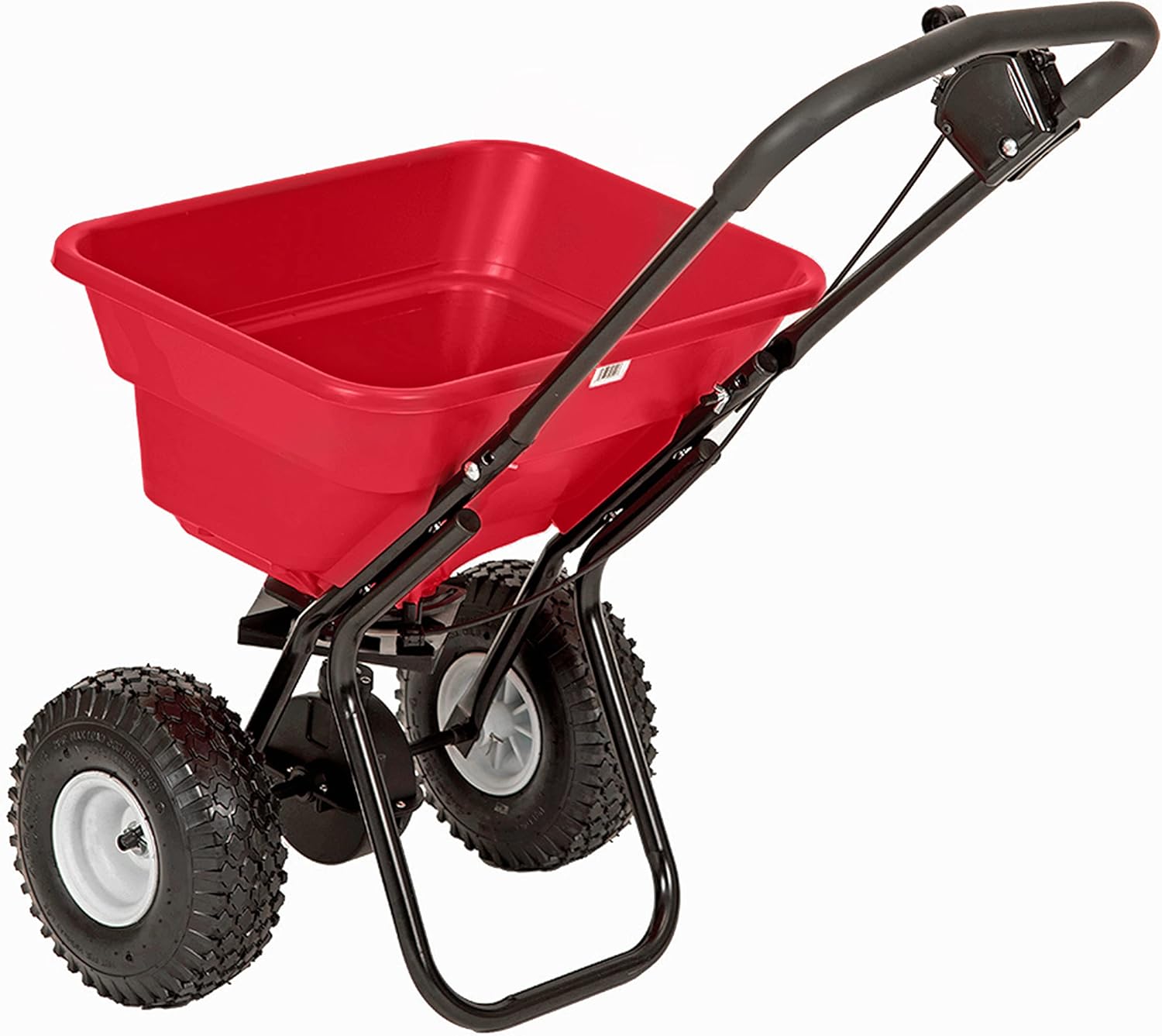
Ready to see current pricing, availability, and customer photos for yourself?
See Latest PriceFrequently Asked Questions
How much fertilizer or seed can the EarthWay 2050P hold at once?
The hopper holds up to 80 pounds, which comfortably fits a full standard 50lb bag of fertilizer or grass seed with room left over, meaning you won’t need to split most bags across multiple loads.
Is this spreader good for overseeding?
Yes, though because grass seed is lighter than fertilizer granules, it throws a narrower pattern than the maximum rated width. Walking slowly and overlapping passes more tightly produces the most even seed coverage.
Does the settings dial match the recommended chart accurately?
It’s reasonably close for most common products, but factors like humidity and granule size variation mean it’s still worth doing a quick calibration test rather than trusting the chart blindly for critical applications.
Can I use this spreader for ice melt or sand in winter?
Many owners do use similar EarthWay spreaders for ice melt products, though the corrosive nature of salt-based ice melt makes thorough rinsing and drying after each use especially important to protect the frame and gate mechanism.
How does it handle hills or sloped lawns?
It handles moderate slopes reasonably well thanks to the pneumatic tires and low center of gravity, though a full 80lb hopper does add noticeable weight on steeper grades, so a firm grip and slower pace are recommended. On very steep slopes, making shorter passes and refilling more often (reducing hopper weight) can make the spreader easier to control safely.
Is assembly difficult?
No — most owners complete assembly in under 20 minutes using basic hand tools. The main steps are attaching the wheels, frame legs, and hopper/handle assembly. EarthWay’s instructions are clear, and video walkthroughs are available online if you prefer visual guidance.
How do I clean it after use?
Rinse the hopper and frame with a hose after each application to remove residue, then let it dry fully before storage. For a complete routine, see our guide on cleaning a lawn spreader.
What size lawn is this spreader best suited for?
It’s best suited for lawns roughly a quarter-acre to one acre in size. Smaller lawns may find it more generally producing more consistent results than it spreader than necessary, while much larger properties may benefit more from a tow-behind option that reduces walking time.
Does it work well with lime and other heavy granular products?
Yes, the gear-driven mechanism does with very lightweight materials like grass seed. Lime pellets are among the easiest products to spread evenly with this model.
Is the handle height adjustable?
No, the handle is fixed at a standard height, which comfortably suits most adult users but isn’t handles heavier, denser granular products like lime effectively, customizable for unusually tall or short operators. If you’re significantly outside average height range, it’s worth checking the published handle height against your own comfort zone before purchasing.
How long does a full hopper load typically last?
A full 80lb load can cover roughly 15,000 to 20,000 square feet depending on the product’s application rate and your chosen dial setting. Heavier application rates use product faster; lighter rates stretch the load further.
Can I use the EarthWay 2050P to spread sand on icy walkways?
Sand can be spread with a broadcast spreader, though its weight and abrasive nature can accelerate wear on the gate mechanism and agitator over time. If you use sand occasionally for traction, it won’t cause immediate damage, but thorough cleaning after each sand application is important to prevent abrasive grit from grinding against moving parts during storage.
What’s the difference between the EarthWay 2050P and the EarthWay 2150?
The 2150 is EarthWay’s commercial-grade model with a larger hopper capacity and heavier construction designed for professional landscapers and larger properties. The 2050P is designed for residential use and offers a better balance of capacity, weight, and maneuverability for typical homeowner needs. For most residential lawns, the 2050P is the more practical and cost-effective choice.
How do I prevent fertilizer from getting on my driveway when spreading?
Close the flow gate before reaching the edge of the lawn adjacent to your driveway, then use a handheld shaker or walk along the edge with the spreader’s throw directed away from the hardscape. A deflector accessory is the most effective long-term solution for properties with extensive driveway borders.
Is it better to spread fertilizer before or after mowing?
Spreading after mowing is generally preferred because shorter grass allows granules to reach the soil surface more easily. If you spread before mowing, wait at least 24–48 hours and water the product in first, so the mower deck doesn’t vacuum up undissolved granules before they’ve had a chance to break down.
Can I leave fertilizer in the hopper between uses during the same season?
It’s not recommended. Even during the active growing season, product left in the hopper can absorb ambient moisture, clump together, and clog the flow gate mechanism. Emptying and rinsing the hopper after each session — even if you plan to use the same product again in a few weeks — prevents buildup and keeps the gate mechanism operating smoothly.
How accurate is the EarthWay settings chart compared to actual application rates?
In testing, the chart settings were within approximately 10–15% of the recommended application rate for standard fertilizers when walking at a moderate, consistent pace. For grass seed and lighter products, the deviation was slightly larger (15–20%), which is why a manual calibration check is recommended for any critical application where precise coverage matters.
What causes the spreader to leave a line of product down the middle of the spread pattern?
A visible center line typically indicates the impeller or agitator isn’t distributing product evenly to both sides. Check that the agitator is properly seated and spinning freely, and that no debris is obstructing the flow gate. Also verify that both tires are inflated evenly, as an uneven stance can tilt the broadcast pattern and create an asymmetric distribution.
Where can I check the current price?
Pricing and availability can change, so it’s best to check the current listing directly rather than relying on a fixed number here.
Final Verdict: Is the EarthWay 2050P Worth It?
After testing across multiple seasonal applications, the EarthWay 2050P earns its long-standing reputation. It isn’t the flashiest spreader on the market, and it won’t win any points for smart features or app connectivity, but that’s not really what it’s trying to be. What it delivers instead is dependable mechanical simplicity: a big hopper, a solid gear drive, and tires that keep the whole unit tracking evenly across real lawns with real bumps and slopes.
The rough edges are minor and mostly tied to physics rather than design flaws — lightweight materials like seed will always throw narrower than heavy fertilizer granules, regardless of which spreader you’re using. For homeowners with a quarter-acre to full-acre lawn who treat their yard multiple times a year, the 80-pound capacity translates directly into fewer interruptions and a more efficient afternoon of yard work.
If your lawn falls within that range and you want equipment that’s built to outlast a single season, the 2050P is a genuinely solid, low-drama choice.
Check today’s price, current stock, and customer reviews before your next lawn treatment.
Check Current Price on Amazon