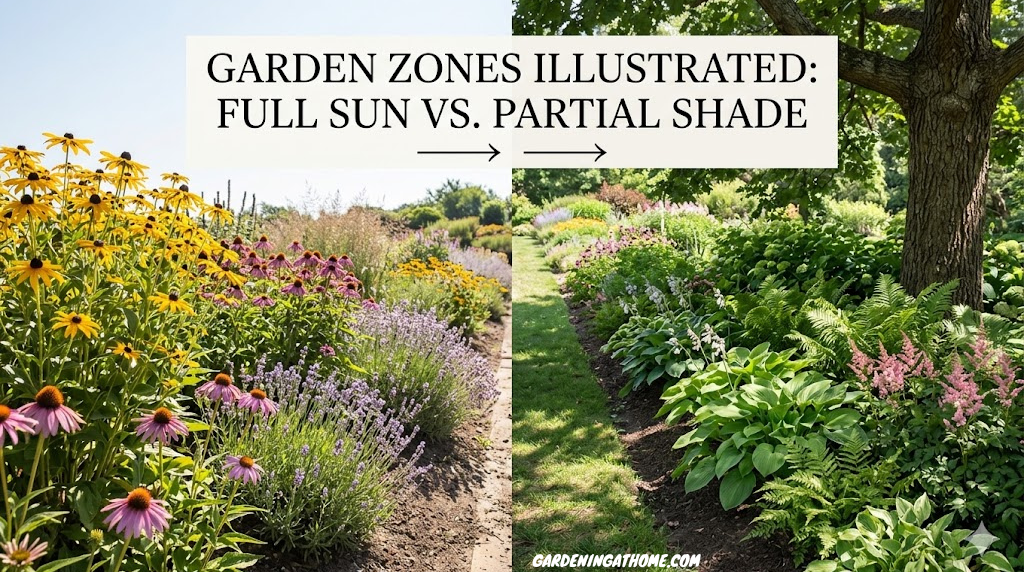
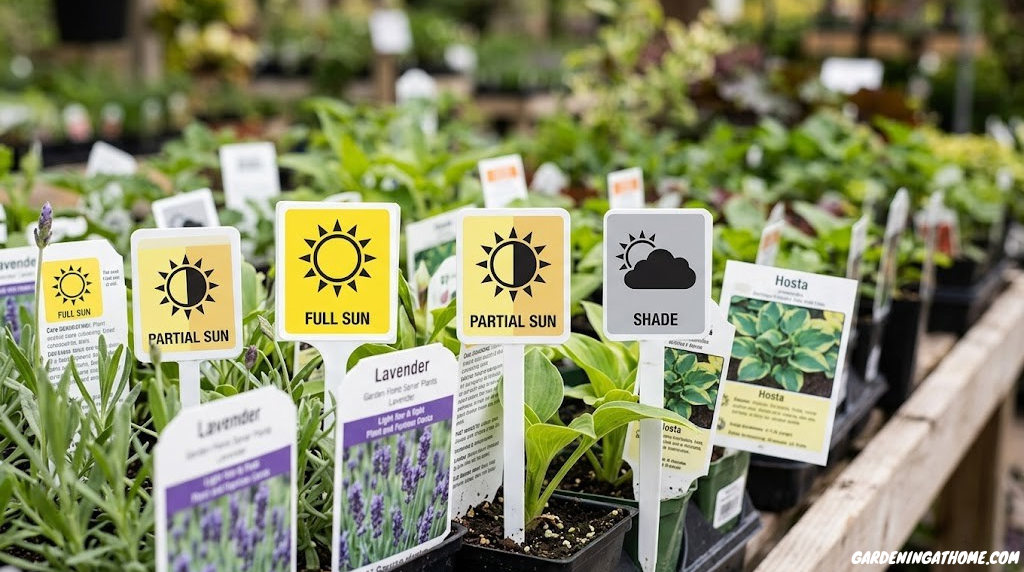
You’ve bought a beautiful perennial from the nursery. The tag says “partial shade.” Your backyard gets sunshine in the morning but is shaded by noon. You plant it — and three weeks later it’s either burned and crispy or leaning desperately toward a sliver of light. Sound familiar?
The labels “full sun,” “partial shade,” and “full shade” are among the most misunderstood pieces of guidance in all of gardening. They appear on nearly every plant tag, seed packet, and online plant profile — yet they’re rarely explained with enough precision for beginners to act on. This guide changes that. By the end, you’ll know exactly what each category means, how to assess your own garden’s light conditions, and which plants will genuinely thrive — not just survive — in each spot.
1. What Do These Labels Actually Mean?
When a plant tag says “full sun,” it is telling you something very specific: this plant needs at least six continuous or cumulative hours of direct, unobstructed sunlight every single day. Not filtered light through a curtain. Not the bright glow you get under a tree canopy. Direct sunlight — the kind that casts a sharp shadow.
The confusion starts because these terms were developed by horticulturalists speaking to a professional audience and then got plastered on mass-market plant tags without accompanying explanation. For a professional grower managing dozens of species across hundreds of acres, “6 hours minimum” is obvious shorthand. For someone just starting a garden from scratch, it’s genuinely unclear — does that mean 6 hours total? In the morning? Does a partially cloudy day count?
Let’s establish the foundational definitions that every plant label rests on:
6 or more hours of direct sunlight per day. Most fruiting vegetables, sun-loving flowering perennials, and many Mediterranean herbs fall into this category. They need that light intensity to fuel flowering, fruiting, and robust growth.
3 to 6 hours of direct sunlight per day. These terms are often used interchangeably but can carry a subtle difference: “partial sun” plants lean toward needing the upper end of that range (4–6 hours), while “partial shade” plants do better at the lower end (3–4 hours). Most commonly, they refer to the same light condition.
Less than 3 hours of direct sunlight per day. True shade plants — ferns, hostas, some mosses — live here. This does not mean total darkness; it means the spot receives minimal direct sun and mostly indirect or ambient light.
There is also a fourth category that isn’t always listed on plant tags but matters enormously in practice:
Light that passes constantly through a tree canopy. Never fully direct, never fully blocked. Many woodland plants evolved in exactly this condition and struggle both in true shade and in periods of intense direct sun.
The difference between these categories is not decorative — it’s physiological. Plants are solar-powered machines. Light drives photosynthesis, which drives the production of sugars, which powers growth, flowering, and fruiting. A tomato plant in partial shade isn’t simply “less happy” — it is literally producing less energy than it needs to form fruit. Understanding this makes the labels feel less like arbitrary gardening rules and more like nutritional requirements.

Stop guessing your garden’s sun hours. This pocket-sized lux meter gives you real readings so you can place plants with confidence in any spot — sun or shade.
Check Price on Amazon →2. The Full Spectrum: All Four Light Categories at a Glance
Before diving deeper into how to use these categories practically, it helps to see them side by side. Here is the complete light spectrum as it applies to garden and container planting:
Notice that “partial sun” and “partial shade” overlap heavily — both describe the 3–6 hour zone. The distinction becomes more meaningful when you layer in the quality of that sun. A spot with 4 hours of intense, direct afternoon sun is very different from a spot with 4 hours of gentle, direct morning sun, even though both technically qualify as “partial.”
This spectrum also explains why so many plant failures come down to zone confusion rather than bad luck or poor technique. A plant placed one full category away from its ideal light requirement is fighting its environment every single day of the growing season.
If you’re just getting started with home gardening, exploring the complete gardening at home resource library can help you build the foundational knowledge that makes decisions like this intuitive rather than stressful.
3. How to Measure Sunlight in Your Garden
The single most valuable thing any gardener can do before buying a single plant is observe and map the light in their space. This is unglamorous work — it involves checking your garden or balcony at regular intervals over the course of one full sunny day — but it transforms guesswork into informed planting.
The Manual Observation Method
On a clear day (no heavy overcast), step outside or look out from every planting area once every hour between 7 AM and 6 PM. For each spot, note whether it is currently in:
- Direct sun — you can see sunlight actually landing on the soil, casting sharp shadows
- Bright indirect light — the sky is bright and open but the sun isn’t directly overhead or at an angle hitting that spot
- Shade — blocked by a building, fence, tree, or the angle of the sun at that time of day
At the end of the day, count the direct sun hours for each area. That number tells you exactly which light category that spot belongs to — and it’s far more reliable than any estimate or assumption.
Using a Light Meter
If you’d prefer a tool that removes any subjectivity, a photosynthetically active radiation (PAR) meter or even a basic lux meter can quantify the light intensity at any point in your garden. These tools are especially useful for indoor spaces where assessing “partial shade” is notoriously difficult. You don’t need an expensive model — even a $20–30 lux meter from Amazon gives readings meaningful enough to categorize your spaces.
The sun’s arc changes dramatically between seasons. A spot that gets 7 hours of direct sun in midsummer might receive only 4 hours in early spring or late autumn — and may be nearly fully shaded in winter. If you’re planting perennials or planning a permanent bed, take light readings at multiple points in the year.
Sun Angle and Compass Orientation
Even without spending a full day watching your garden, understanding compass orientation gives you a reliable starting prediction:
| Facing Direction (Northern Hemisphere) | Typical Light Condition | Best Candidate Plants |
|---|---|---|
| South-facing | Full sun (maximum exposure) | Tomatoes, lavender, rosemary, roses |
| East-facing | Morning sun / afternoon shade (gentle partial shade) | Hydrangeas, ferns, impatiens, mint |
| West-facing | Afternoon sun / morning shade (hotter partial shade) | Coneflowers, black-eyed Susan, ornamental grasses |
| North-facing | Full shade or deep partial shade | Hostas, astilbe, hellebores, mosses |
Note that these are starting estimates — trees, buildings, fences, and neighboring structures can significantly alter the predicted exposure. Always verify with direct observation or a meter before making major planting decisions.

Know exactly which direction your beds face and predict seasonal sun paths. Takes the guesswork out of planning sun and shade sections in any garden layout.
Check Price on Amazon →4. Morning Sun vs Afternoon Sun: Why the Timing Matters
Not all sunshine is created equal. Two spots in your garden might each receive exactly four hours of direct sun — but if one gets that sun between 7 AM and 11 AM while the other gets it between 2 PM and 6 PM, the plants in each spot will experience those four hours very differently.
Why Afternoon Sun Is More Intense
The position of the sun in the sky changes throughout the day. In the late morning and afternoon, the sun is higher in the sky (in summer especially), which means its rays travel through a thinner slice of atmosphere and hit surfaces at a more direct angle. The result: higher UV intensity, greater heat accumulation at the soil and leaf surface, and faster moisture evaporation.
Morning sun, by contrast, arrives at a lower angle, has traveled through more atmosphere, and carries less radiant heat. For most plants, morning sun is gentler and more forgiving — it provides the light energy needed for photosynthesis without the desiccating intensity of peak afternoon.
Practical Implications for Plant Selection
When a plant label says “partial shade,” understanding whether your available partial shade comes from morning or afternoon determines which specific shade plants to choose:
🌅 Morning Sun + Afternoon Shade
- The most desirable partial shade condition
- Cool afternoons protect moisture-sensitive leaves
- Works well for: impatiens, begonias, fuchsia, bleeding heart
- Best for woodland species adapted to forest edge conditions
- Generally easier on water needs
☀️ Morning Shade + Afternoon Sun
- More intense and more demanding condition
- Can dry out quickly even if total sun hours are equal
- Not suitable for shade plants labeled as “partial shade”
- Better for drought-tolerant perennials and ornamental grasses
- Requires more careful watering in summer
This is why experienced gardeners sometimes distinguish between “morning partial shade” and “afternoon partial shade” as almost entirely different growing conditions — even though both technically fall within the 3–6 hour category on paper.
5. Reading Plant Labels and Seed Packets Correctly
Plant labels are small pieces of real estate trying to communicate a lot of critical information. The light requirement icons and text are almost always standardized, but the way they’re communicated varies between manufacturers and countries. Here’s how to parse the most common label formats:
Common Label Phrases and What They Really Mean
| Label Text | Actual Meaning | Daily Sun Hours |
|---|---|---|
| Full Sun | Needs 6+ hours of direct sunlight daily to perform well | 6–8+ hours |
| Partial Sun | Adapts well but prefers more sun in the 3–6 hour range | 4–6 hours |
| Partial Shade | Adapts well but prefers less sun in the 3–6 hour range | 3–4 hours |
| Full Shade | Performs best with under 3 hours of direct sun | 0–3 hours |
| Full Sun to Partial Shade | Genuinely adaptable; will grow in either but may behave differently | 3–8+ hours |
| Shade to Partial Shade | Primarily shade-adapted; can handle some direct morning light | 0–4 hours |
Some nurseries and mass-market stores use optimistic light labels to increase sales. A plant labeled “partial shade” may technically survive in deep shade but will never flower, remain stunted, and eventually decline. Always cross-reference labels with a reputable plant database or extension service recommendation for that specific species.
It’s also worth noting that light requirements can vary within a species based on climate. A plant growing in a cool coastal climate can handle more direct sun than the same species growing in a hot, dry interior climate. Labels are typically calibrated to “average” growing conditions — which may or may not match your specific garden’s microclimate.
When you’re choosing tools and resources to support your garden decisions, a solid set of essential gardening tools for beginners can make the observation and planting process significantly more organized and rewarding.
6. Best Plants for Full Sun Conditions
Full sun plants are typically your most productive and visually dramatic performers — they evolved in open meadows, hillsides, and exposed positions where sunlight is plentiful and competition for it is fierce. They tend to be drought-tolerant, aromatic (the volatile oils that give herbs their scent are partly sun-induced), and strong-stemmed.
Full Sun Perennials and Flowers
Full Sun Shrubs
Full Sun Edibles
Almost all fruiting vegetables are full sun plants by necessity — the energy required to form fruit simply cannot be produced without significant daily light input. This is why tomatoes planted in shady corners are a recurring beginner disappointment. For beginners growing vegetables in containers, always prioritize the sunniest available spot for any fruiting crops.
✅ Full Sun Edibles That Reward You
- Tomatoes — minimum 6 hours, 8+ ideal
- Peppers — 6–8 hours, love heat
- Zucchini and squash — 6+ hours
- Cucumbers — 6–8 hours
- Beans (climbing and bush)
- Basil — actually a full sun herb
- Corn — needs full sun plus adequate spacing
❌ What Full Sun Plants Struggle With
- Poor performance in under 5 hours direct sun
- Legginess (stretching toward light)
- Failure to flower or fruit in shade
- Increased disease pressure in low-light, high-humidity shade
- Inconsistent ripening and flavor in vegetables
If you’re growing tomatoes specifically in a limited-space setting, our detailed guide on growing tomatoes on a balcony covers how to maximize sun exposure for container crops in constrained environments.

Position raised beds exactly where sun exposure is maximized. This premium steel bed resists rust, retains warmth, and gives full-sun crops the growing conditions they thrive in.
Check Price on Amazon →7. Best Plants for Partial Shade
Partial shade gardens have a reputation for being limited — but that’s a misunderstanding rooted in not knowing the right plants. Some of the most lush, sophisticated, and architecturally interesting garden combinations happen in partial shade, where foliage colors, textures, and forms take center stage over flowers.
Partial Shade Perennials
Partial Shade Flowering Annuals
Partial Shade Shrubs
When you lose flower diversity in shade, you gain foliage diversity. Focus on layering three to four distinct leaf sizes, textures (smooth, deeply cut, waxy, fuzzy), and colors (chartreuse, deep green, burgundy, silver). The combination creates visual interest that outperforms a flower-dense full-sun border for much of the season.
8. Vegetables and Light Requirements: The Definitive Breakdown
For food gardeners, light requirements have a direct impact on yield and flavor — not just aesthetics. Understanding which vegetables tolerate shade and which absolutely must have sun is one of the most important practical applications of the full sun vs partial shade framework.
The Rule of Edible Plants and Light
A useful shortcut: edible plants that you harvest for their fruit, seed, or root need more sun. Edible plants harvested for their leaves can often tolerate more shade. This maps directly to plant physiology — leaves are solar panels; fruit and root production requires enormous energy output that only full sun can sustain.
| Vegetable / Herb | Minimum Sun Needed | Optimal Condition | Shade Tolerance? |
|---|---|---|---|
| Tomatoes | 6 hours | 8+ hours | Low — poor fruit set and flavor |
| Peppers | 6 hours | 8 hours | Low |
| Zucchini / Squash | 6 hours | 8 hours | Low |
| Cucumbers | 6 hours | 8 hours | Low — very poor in shade |
| Lettuce | 4 hours | 4–6 hours | Moderate — actually benefits from afternoon shade in heat |
| Spinach | 3–4 hours | 4–5 hours | Moderate — shade extends harvest by delaying bolting |
| Kale | 4 hours | 6 hours | Moderate |
| Arugula | 3–4 hours | 4–5 hours | Good — benefits from afternoon shade in warm seasons |
| Radishes | 4 hours | 6 hours | Moderate |
| Mint | 3–4 hours | 4–6 hours | Good — actually invasive in favorable shade conditions |
| Basil | 6 hours | 8 hours | Low — flavor suffers significantly in shade |
| Parsley | 4 hours | 4–6 hours | Moderate |
The opportunity hidden in partial shade is the ability to extend the harvest of cool-season crops that bolt (go to seed) quickly in full sun heat. Lettuce, arugula, and spinach planted deliberately in a partially shaded bed will often continue producing weeks longer than the same crops planted in full sun, because the reduced afternoon heat slows the trigger to bolt. For gardeners growing in tight spaces, this is a meaningful strategy for maximizing production.
If you’re exploring ways to grow more food in limited space, see also our guide to growing microgreens at home without soil — one of the very few high-yield food crops that actually grows well in lower light conditions indoors.

When natural sunlight is insufficient for your growing goals, a quality grow light lets you supplement or even replace sun for herbs, microgreens, and leafy vegetables year-round.
Check Price on Amazon →9. Understanding Garden Microclimates: Your Garden Within Your Garden
Every garden contains multiple microclimates — small areas where temperature, moisture, wind, and light differ from the broader surrounding environment. Understanding microclimates is the advanced layer of the full sun vs partial shade conversation, because a single garden can contain full sun, partial shade, and even full shade zones within meters of one another.
South-Facing Walls & Fences
Absorb and re-radiate heat throughout the day. Create warm, protected microclimates that often run 2–5°C warmer than the open garden. Excellent for tender plants and heat-loving crops.
Under Tree Canopies
Create dappled shade, root competition, and often dry conditions due to the tree intercepting rainfall. Specialized plant selection is essential — don’t assume “partial shade” plants will work here.
Wind-Exposed Corners
Even in a sunny spot, exposed wind can increase water loss dramatically, reducing effective growing conditions below what light measurements would suggest. Wind-breaks improve overall conditions.
Low-Lying Areas
Cold air pools in depressions and low spots overnight, creating frost pockets where temperatures can be several degrees colder. Can also be moist due to runoff collection.
Recognizing and mapping microclimates in your own garden is one of the most effective ways to stop fighting your environment and start working with it. A full sun plant placed in a warm, south-facing wall microclimate may perform better than the same plant in an open, full sun area simply because the wall adds accumulated heat that extends the effective growing day.
For those gardening in containers on balconies or small outdoor spaces, microclimates become even more significant — a covered balcony with reflected light from walls, or a sunny corner between two buildings, can behave very differently from what compass orientation alone would suggest. If you garden in a limited outdoor space, our guide to balcony gardening ideas for apartments discusses how to assess and exploit these small-scale light conditions effectively.
10. What Happens When Plants Get the Wrong Light Conditions
Understanding the consequences of misplaced plants is as important as knowing the right conditions — because recognizing these symptoms tells you when to act before it’s too late. Most plants will send clear distress signals when they’re receiving inadequate or excessive light.
Signs a Sun-Loving Plant Isn’t Getting Enough Light
- Etiolation: The plant stretches abnormally toward any available light source, becoming long-stemmed, weak, and floppy
- Pale or yellowing leaves: Chlorophyll production slows when light is insufficient, causing generalized yellowing
- Failure to flower: Most fruiting and flowering full-sun plants will not initiate bloom cycles without adequate light
- Small leaves: Plants reduce leaf size and alter angle to capture more light in compensation
- Slow or stunted growth: Energy production is insufficient for normal growth rates
- Increased susceptibility to disease: Particularly fungal diseases thrive in the damp, low-light conditions that shade creates
Signs a Shade Plant Is Getting Too Much Sun
- Leaf scorch: Brown, crispy edges or bleached white/yellow patches on leaves — the most telltale sign
- Wilting in full sun periods: Even when soil moisture is adequate, the plant’s water transport system can’t keep up with evaporation rate
- Rolled or cupped leaves: A protective mechanism to reduce surface area exposed to sun
- Bleached or faded leaf color: Particularly noticeable in plants valued for dark foliage like coral bells
- Stunted or stopped growth in summer: A heat and light stress response
The good news is that most plants recover when moved to appropriate conditions — though sun-scorched leaves won’t repair themselves and should be removed. For more help diagnosing plant problems, our guide to signs of overwatering vs underwatering can help you distinguish light-related stress from moisture-related issues, as their symptoms can overlap significantly.
When Soil and Light Interact
It’s worth noting that light and soil conditions interact in complex ways. A shade plant in average soil may survive moderate direct sun because its roots are finding consistently cool, moist soil. The same plant in sandy, fast-draining soil may wilt within days of a heat wave under identical light conditions. When diagnosing plant problems, always consider light, water, and soil as a connected system rather than independent variables. Choosing the right potting soil mix becomes especially important when you’re placing plants near the edge of their light tolerance.
11. How to Adapt and Modify Light in Your Garden
The light conditions in your garden aren’t entirely fixed. Within meaningful limits, you can increase available sunlight in shaded areas or create shade in exposed ones. These interventions give you meaningful flexibility when you want to grow plants whose ideal light requirements don’t perfectly match what you have naturally.
Strategies to Increase Sunlight
☀️ Create More Sun
- Strategic pruning: Remove lower branches from trees to raise the canopy and let more sunlight reach the ground
- Remove or relocate shade structures: Fences, sheds, and overhead trellises can often be modified or repositioned
- Use reflective surfaces: White-painted walls, fences, or reflective mulches can redirect ambient light toward planting areas
- Grow vertically: Raising planters higher (on stands or walls) can move them above local shade sources like fences
- Supplement with grow lights: For container gardens and indoor spaces, full-spectrum LED lights can add meaningful light hours
🌑 Create More Shade
- Shade cloth: 30–70% shade cloth suspended above beds dramatically reduces direct sun intensity
- Trellises with climbing plants: A fast-growing annual vine on a trellis creates adjustable seasonal shade
- Strategic tall plant placement: Using tall plants (sunflowers, corn, Jerusalem artichoke) to shade adjacent beds
- Pergolas and arbors: Permanent overhead structures with vine coverage provide regulated dappled shade
- Timing strategies: Planting shade-needing crops on the north side of taller crops
Shade cloth is one of the most underrated and practical gardening tools available. Available in different percentages (30%, 50%, 70% light reduction), it lets you precisely engineer the light conditions for specific beds. It’s particularly valuable in climates with intense summer heat, where a 30–50% shade cloth over full-sun crops like lettuce can extend the productive season by preventing premature bolting without meaningfully reducing growth.
For indoor plants where artificial light is the primary source, a full-spectrum LED grow light becomes the equivalent of repositioning your garden bed — you control exactly how many hours of “sunlight” your plants receive. This is especially relevant if you’re exploring starting an indoor herb garden in a home with limited south-facing window space.

Convert a full-sun spot into perfect partial shade for lettuce, spinach, and heat-sensitive herbs. Includes grommets and ties for easy installation over raised beds or hoops.
Check Price on Amazon →12. Indoor Plants and Light Categories: Why Indoor “Sun” Is Different
The full sun vs partial shade framework was developed for outdoor conditions, but it absolutely applies to indoor plant selection — with one critical modification: indoor light is dramatically weaker than outdoor light, even in the brightest, most sun-drenched room of your home.
The Indoor Light Reality Check
Direct outdoor sunlight at midday delivers roughly 50,000 to 100,000 lux of light intensity. A bright, sunny south-facing windowsill — the best indoor light condition in most homes — delivers approximately 5,000 to 10,000 lux. That’s a 10x reduction in light intensity before you even factor in glass filtering UV, curtains, interior walls blocking low-angle winter sun, or the plant being a meter away from the window rather than right on the sill.
This is why a “full sun” outdoor plant will almost never genuinely thrive indoors without supplemental lighting — and why plants labeled “low light” indoors are not the same as “shade plants” outdoors. The categories shift significantly in meaning between environments.
Indoor Light Category Equivalents
| Indoor Light Condition | Outdoor Equivalent | Best Plant Types |
|---|---|---|
| Bright direct light (south window, on sill) | Partial sun / lower end of full sun | Succulents, cacti, some herbs (basil), geraniums |
| Bright indirect light (near south/east window, no direct beam) | Partial shade (upper range) | Most houseplants: pothos, philodendron, peace lily, spider plant |
| Medium indirect light (interior of room, some ambient light) | Partial to full shade | Snake plant, ZZ plant, cast iron plant |
| Low light (north window, interior corner) | Full shade / deep shade | Cast iron plant, pothos (survives), ferns (marginally) |
Notice that even the best indoor light condition only reaches the lower end of outdoor full-sun — which is why truly “full sun” plants like rosemary, basil, and pelargoniums struggle indoors without supplemental light. They’re not getting the photon quantity they were evolved to receive, no matter how sunny your home feels to human eyes.
Hold a piece of white paper near your plant’s location and hold your hand about 12 inches above it in typical mid-morning light. Sharp, well-defined shadow = bright indirect light or better. Faint, soft shadow = medium indirect. No visible shadow = low light. This simple test doesn’t require any tools.
For a comprehensive guide to placing houseplants based on their real light needs, our resource on best indoor plants for low light covers specifically which species will thrive in the dimmest indoor conditions — and which ones are commonly misjudged as low-light tolerant when they actually need more. Similarly, for anyone interested in the air quality benefits of certain houseplants, indoor plants that purify the air includes light requirement data for each species covered.
For pot-grown plants indoors, light and container size interact — a root-bound plant in the wrong pot size is already stressed before you factor in inadequate light. The combination of light awareness and correct pot sizing (covered in our guide to choosing the right pot size for plants) gives indoor plant success a much stronger foundation.
Using Grow Lights to Correct Indoor Light Deficits
If your home simply doesn’t have the natural light that certain plants need, grow lights offer a genuine solution — not just a workaround. Modern full-spectrum LED grow lights are energy-efficient enough to run for 12–16 hours per day without meaningfully affecting your electricity bill, and they provide the specific wavelengths (blue for vegetative growth, red for flowering and fruiting) that plants use most efficiently.
A grow light positioned 6–12 inches above the canopy of herbs, microgreens, or seedlings for 14–16 hours daily provides something close to genuine outdoor partial sun conditions in terms of daily light integral — the cumulative photon exposure plants use to regulate growth cycles. This is particularly valuable in winter months when even south-facing windows deliver dramatically reduced light due to lower sun angles and shorter days.
Plants also need appropriate nutrition to make the most of any light they receive. If you’re supplementing light with grow lights or optimizing a full-sun outdoor setup, understanding how and when to fertilize houseplants ensures that light isn’t the only variable you’ve optimized — nutrients matter equally for reaching each plant’s full potential in any light condition.
Frequently Asked Questions
What is the difference between full sun and partial shade?
Full sun means a plant needs at least 6 hours of direct sunlight per day. Partial shade means 3–6 hours of direct sun, often with protection during the hottest afternoon hours. The distinction matters because it affects how plants photosynthesize, grow, flower, and produce fruit.
Does partial shade mean no direct sun at all?
No. Partial shade still includes direct sunlight — just less than 6 hours per day. A spot with bright morning sun and shade from noon onward is a classic partial shade environment. The direct sun hours that partial shade plants receive are essential to their health and flowering; without any direct sun at all, most partial shade plants will decline.
Is 6 hours of sun enough for vegetables?
For most fruiting vegetables like tomatoes, peppers, and zucchini, 6 hours is the minimum but 8+ hours is ideal. You’ll often get smaller yields and slower ripening with exactly 6 hours compared to 8 or more. Leafy vegetables and herbs like lettuce, spinach, and parsley often do well with 4–6 hours, which makes them better candidates for partial shade spots.
Can a full-sun plant survive in partial shade?
It depends on the plant and the degree of the mismatch. Many full-sun plants will survive in partial shade but will produce fewer flowers, less fruit, and often have leggier, weaker growth. Some full-sun annuals like zinnias and marigolds simply refuse to bloom without adequate light. Perennial full-sun plants often persist for years in partial shade but never reach their ornamental or productive potential.
What is the difference between partial shade and dappled shade?
Partial shade involves distinct blocks of direct sun and shade throughout the day — a spot that gets full morning sun, then is fully shaded from noon onward. Dappled shade is more diffuse — light filtering constantly through a tree canopy, never fully direct but never fully blocked. Many woodland plants prefer dappled over partial shade because they evolved under forest canopies where constant filtered light was available rather than alternating blocks of intense sun and deep shade.
Does afternoon sun count the same as morning sun?
Not exactly. Afternoon sun is typically more intense and hotter than morning sun, especially in warmer climates. Two hours of direct afternoon sun can stress plants adapted to morning sun, even if total hours match. This is why many experienced gardeners specify not just how much sun a spot receives, but when that sun arrives — and why east-facing beds (morning sun) are often preferred for shade-border plants over west-facing beds (afternoon sun).
How do I measure sunlight in my garden?
The most reliable method is direct observation: check your garden every hour from sunrise to sunset on a clear day and note when specific spots are in full sun vs shade. You can also use a light meter or a sun calculator app. Do this at different times of year since sun angles change with the seasons. Even a single full-day observation gives you enormously more accurate data than any estimate based on compass direction alone.
Can I grow plants in full shade?
Yes, if you choose the right plants. True full shade plants — like hostas, ferns, astilbe, hellebores, and some mosses — can thrive with less than 3 hours of direct light or even with only ambient indirect light throughout the day. However, very few edibles do well in full shade (mint and some leafy herbs being partial exceptions), and flowering is usually limited to those species specifically adapted to bloom without high light levels.
Why do some seed packets say “full sun to partial shade”?
This label means the plant is genuinely adaptable and performs acceptably in both conditions, though behavior may differ. In full sun it might grow faster, produce more flowers, or develop more compact growth. In partial shade it might have more vivid leaf color, need less watering, or produce larger individual leaves. These flexible plants are excellent choices for gardeners who have mixed light conditions across their space.
Does reflected light from walls or fences count as sunlight?
Reflected light does add warmth and some intensity to a growing area, which is why south-facing walls (in the Northern Hemisphere) create warmer microclimates than the surrounding garden. However, reflected light is not the same as direct sunlight and cannot substitute for a full-sun requirement — it lacks the photon intensity that plants use for photosynthesis. It does contribute to overall plant warmth and faster soil temperature, which can be beneficial in spring planting.
What happens if I plant a shade plant in full sun?
Shade plants in full sun typically show leaf scorch — brown, crispy edges or bleached white/yellow patches on leaves. They may wilt during the hottest part of the day, stop growing, or gradually die back. The damage is often visible within days of a heat wave. Some shade plants will survive if watered very frequently and if the full sun exposure isn’t too intense (such as in cooler northern climates), but they will rarely thrive and will require significantly more maintenance than if properly placed.
Do indoor plants follow the same full sun vs shade rules?
The categories apply indoors too, but indoor light intensity is dramatically lower than outdoor light — even a bright south-facing window provides roughly 1/10th the intensity of direct outdoor sun. This means that most “full sun” plants struggle indoors and require grow light supplementation to thrive. “Low light” indoor plants are not equivalent to outdoor shade plants — they’re specially adapted to the extremely low light intensity typical of interior spaces. Always check specific species requirements for indoor settings rather than assuming outdoor labels translate directly.
Conclusion: Stop Guessing, Start Observing
The difference between a garden that thrives and one that struggles often comes down not to soil quality, watering frequency, or fertilizer choice — but to the quiet, foundational question of how much sun each plant is actually receiving every day.
Full sun and partial shade aren’t arbitrary labels. They encode real physiological requirements that determine whether a plant will photosynthesize enough energy to flower, fruit, and remain healthy through the season. Respect those numbers and you’ll be ahead of the majority of gardeners who’ve never spent a day watching where the light actually falls in their garden.
The action that will immediately improve your gardening success: take one full clear day, step outside every hour, and map your garden’s actual light. Then match your plant selection to that map rather than the map you wish existed. The plants will tell you — through their growth, flowering, and health — whether you got it right.
For everything else you need to build a thriving garden from the ground up, explore our full library of home gardening guides at Gardening at Home — and check out our beginner-friendly resource on cheap gardening ideas for beginners to make every square foot of light you have work harder.
Start Your Garden from Scratch →